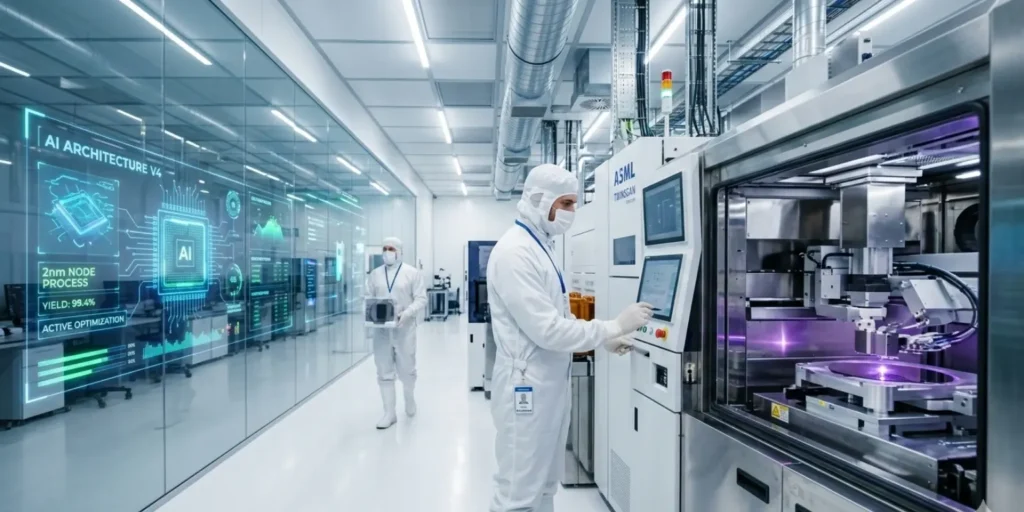
“Engineers at a semiconductor fab monitor wafer production as AI demand drives global chip shortages.”
The rapid expansion of artificial intelligence (AI) technologies is creating unprecedented demand for advanced semiconductors, but global supply chains may not be able to keep up. Recently, SK Group chairman Chey Tae-won issued a stark warning at the NVIDIA GTC Conference in California, emphasizing that chip wafer shortages could continue well into the next decade, potentially lasting until 2030.
The comments highlight the structural challenges facing the semiconductor industry as AI adoption accelerates across data centers, cloud computing, autonomous vehicles, and consumer electronics.
Rising Demand for High-Bandwidth Memory
At the conference, Chey Tae-won stressed that the AI boom is fueling an unprecedented demand for high-bandwidth memory (HBM) and other advanced semiconductor components. HBM is critical for AI workloads, as it enables extremely fast memory access, which is essential for processing the large datasets AI models require. Companies such as NVIDIA rely heavily on HBM for their GPUs, which power large-scale AI training and inference.
“The rapid growth of AI is putting a tremendous strain on wafer supply,” Chey said, noting that shortages could exceed 20% in the coming years. As AI workloads expand, companies need chips that can handle increasingly complex neural networks, driving demand for wafers beyond what current production capacity can provide.
Why Expanding Wafer Production Isn’t Easy
Chey highlighted that increasing wafer production is not a simple solution. Semiconductor fabrication is an extremely capital-intensive industry, requiring billions of dollars for new facilities, skilled labor, and advanced cleanroom technology. Even if manufacturers wanted to rapidly expand production, construction timelines and workforce constraints make it nearly impossible to quickly close the supply gap.
Adding to the challenge, SK Group and other South Korean manufacturers are focusing on boosting domestic production rather than building overseas facilities. Factors such as energy availability, water supply, construction resources, and geopolitical stability make rapid international expansion difficult.
SK Hynix Strategies to Stabilize Supply
SK Group’s semiconductor arm, SK Hynix, is implementing strategies to stabilize DRAM and HBM production amid global shortages. These include process improvements, efficiency gains, and prioritization of high-demand products for AI applications.
Additionally, SK Hynix is exploring the possibility of issuing American Depositary Receipts (ADRs) to attract more international investment, signaling confidence in its long-term strategy despite the supply constraints. By raising capital, the company aims to strengthen its domestic production capabilities while navigating a volatile global semiconductor market.
Geopolitical and Energy Challenges
The semiconductor shortage is compounded by geopolitical tensions that affect energy costs and supply chain stability. High-energy consumption is a major factor in semiconductor fabrication, and rising electricity prices increase production costs. SK Group is reportedly exploring alternative energy sources to mitigate these pressures, ensuring that domestic wafer production remains feasible and cost-effective.
The geopolitical landscape also influences raw material availability, trade restrictions, and investment decisions, further complicating efforts to expand capacity. This combination of high AI-driven demand and constrained supply underlines the systemic nature of the challenge facing the semiconductor sector.
Implications for the AI and Tech Industries
The wafer shortage has broad implications for technology companies, data centers, and AI research.
- Rising Component Costs: AI chipmakers may face higher production costs as wafer prices climb, potentially increasing prices for GPUs and memory modules.
- Slower Product Launches: Limited wafer availability could delay new AI hardware launches, affecting companies that rely on cutting-edge processors for cloud computing, gaming, and enterprise applications.
- Increased Competition for Resources: Companies will need to compete for limited HBM and DRAM supplies, which may favor larger, established players like NVIDIA, AMD, and SK Hynix, leaving smaller startups at a disadvantage.
- Acceleration of Innovation: Supply constraints could incentivize chipmakers to develop more efficient architectures or explore alternative memory technologies to reduce reliance on high-demand wafers.
Long-Term Industry Outlook
Industry analysts suggest that the semiconductor shortage could be structural, not just cyclical. While temporary fluctuations are normal, the convergence of AI-driven demand, high-capacity memory requirements, and complex fabrication processes points to a prolonged supply crunch.
Chey Tae-won’s projection that shortages could last until 2030 highlights the need for strategic planning across the industry. Companies may increasingly focus on:
- Expanding domestic production with advanced fabs
- Investing in process innovations for higher wafer yields
- Diversifying supply chains and exploring alternative memory solutions
- Developing energy-efficient manufacturing techniques
Conclusion
The AI boom has propelled the semiconductor industry into uncharted territory, creating demand for high-performance chips and HBM that far outpaces current supply. SK Group’s warning serves as a wake-up call for investors, manufacturers, and technology companies: solving the wafer shortage is not a short-term task, and industry players must adopt long-term strategies to navigate these constraints.
As AI becomes increasingly central to industries ranging from cloud computing to autonomous systems, the semiconductor sector’s ability to meet demand will be critical. Despite the challenges, SK Group and SK Hynix remain committed to stabilizing production and investing in domestic capabilities, signaling confidence in the long-term growth potential of AI-driven technology.
The next decade will likely see intense competition, innovation, and strategic planning as the world grapples with the intersection of AI expansion and semiconductor supply limitations—a challenge that could define the technological landscape for years to come.
About The Author