
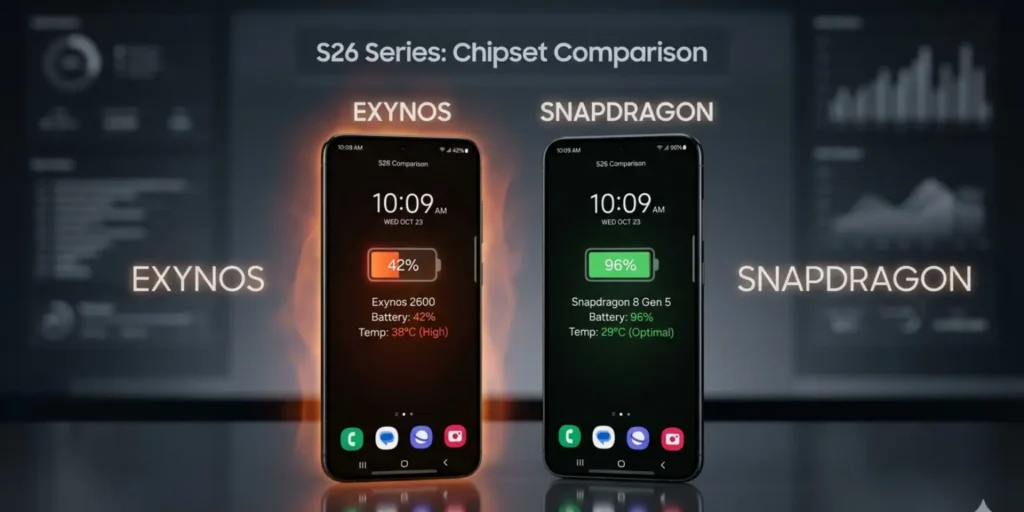
Side-by-side comparison of Galaxy S26 Exynos and Snapdragon models showing battery performance difference and heat levels.
The Samsung Galaxy S26 is once again at the center of a familiar discussion. Samsung has released two versions of its flagship phone, one powered by its own Exynos chip and the other using a Qualcomm Snapdragon processor.
Recent real-world testing shows a noticeable difference in battery life between the two, with the Exynos model falling behind. This is surprising, especially since the Exynos chip is built on newer 2nm technology, which should, in theory, be more efficient. So what’s really going on?
Test Results: A Clear Gap
In a side-by-side comparison, both versions of the Galaxy S26 were put through everyday tasks such as:
- Phone calls
- 4K video recording
- Gaming
- Social media use
- Navigation
- Streaming
Both devices were tested under the same conditions, including active 5G usage and no WiFi.
The results were quite clear:
- The Exynos-powered S26 lasted 6 hours and 48 minutes
- The Snapdragon version lasted 9 hours and 26 minutes
That’s a difference of nearly 2.5 hours, or about 28% longer battery life in favor of the Snapdragon model.
The Chips Behind the Difference
The two processors at the center of this comparison are:
- Exynos 2600
- Snapdragon 8 Elite Gen 5
The Exynos 2600 is particularly important because it represents Samsung’s move into 2nm chip manufacturing, a major milestone in the semiconductor industry.
Meanwhile, the Snapdragon chip is built using a 3nm process by TSMC, a company known for its strong efficiency and manufacturing consistency.
Why the Exynos Chip Performs Worse
At first glance, a 2nm chip should be more efficient than a 3nm one. Smaller transistors usually mean better power efficiency and performance. But in this case, real-world results tell a different story.
1. Higher Power Consumption
The Exynos 2600 reportedly pulls up to 30W under peak load, while the Snapdragon chip uses around 21W for similar performance. That is a significant difference. More power usage directly translates to faster battery drain.
2. Heat and Thermal Throttling
Higher power draw also means more heat. When a chip heats up:
- The system reduces performance to cool it down
- Efficiency drops
- The battery drains faster
This creates a cycle where the chip is both consuming more power and delivering less efficiency.
3. Early-Stage 2nm Technology
Although 2nm sounds impressive, newer manufacturing processes are not always perfect in their first generation. Samsung’s chip division, Samsung Electronics, may still be optimizing how this technology performs in real-world conditions. In contrast, Qualcomm has years of experience working with TSMC’s highly refined manufacturing processes.
4. Software and Optimization
Hardware is only part of the story. Chip performance also depends on how well it is optimized with software.
Snapdragon chips often benefit from:
- Better app compatibility
- Stronger developer support
- More mature performance tuning
This gives Qualcomm an edge in everyday usage, even if the raw specs seem similar.
What This Means for Users
For everyday users, the difference is simple:
- The Snapdragon version offers longer battery life
- The Exynos version may require more frequent charging
- Performance differences may also appear during heavy tasks like gaming
This could influence buying decisions, especially in regions where only one variant is available.
A Familiar Pattern
This is not the first time Samsung’s Exynos chips have lagged behind Snapdragon versions. Over the years, users have often reported:
- Lower efficiency
- Higher heat output
- Slightly weaker performance
The Galaxy S26 shows that while Samsung is pushing forward with new technology, it still has work to do to match or surpass Qualcomm in real-world performance.
Final Thoughts
The Samsung Galaxy S26 highlights an important lesson in tech: newer does not always mean better. While the Exynos 2600 represents a big step forward with 2nm technology, it struggles with efficiency in its current form. Meanwhile, the Snapdragon 8 Elite Gen 5 delivers more consistent and reliable performance, especially when it comes to battery life.
For now, if battery life is your top priority, the Snapdragon version is clearly the better choice. But as Samsung continues to refine its chip technology, future versions of Exynos may close this gap.
About The Author