
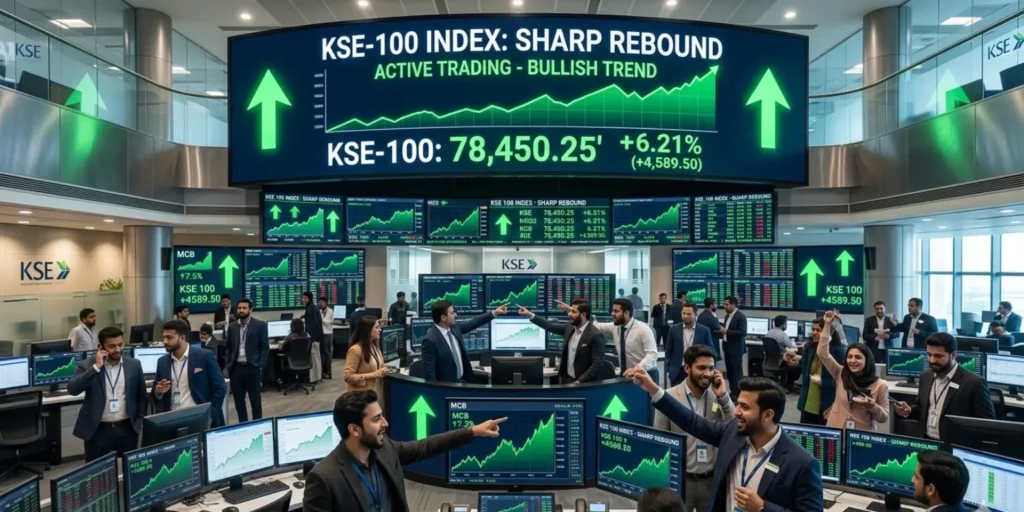
Pakistan Stock Exchange rebounds strongly as the KSE-100 Index posts a sharp gain driven by investor confidence.
PSX witnessed a powerful recovery on Tuesday as investors returned to the market with renewed confidence. The benchmark KSE-100 Index surged sharply in early trading, reversing the heavy losses recorded in the previous session.
The index climbed to 151,503.46 points, gaining more than 2,300 points shortly after the opening bell. This strong upward movement signaled a shift in investor sentiment, as buyers stepped in across multiple sectors to capitalize on attractive valuations following the recent dip.
Market participants viewed the rebound as a technical recovery supported by improved fundamentals. After a steep sell-off, investors often re-enter the market to take advantage of lower prices, which can trigger a rapid upward correction when buying pressure outweighs selling activity.
External Sector Boosts Investor Confidence
A key factor behind the positive sentiment was encouraging economic data released by the State Bank of Pakistan. Pakistan recorded a current account surplus of $427 million in February 2026, providing reassurance about the country’s external financial position.
The surplus was driven by strong remittance inflows, improved export performance, and controlled import growth. These factors indicate a healthier balance of payments situation, which is crucial for maintaining currency stability and reducing reliance on external financing.
For investors, such macroeconomic improvements often translate into increased confidence in the equity market. A stable external account reduces economic uncertainty and creates a more favorable environment for corporate growth and investment.
Broad-Based Gains Across Key Sectors
The rally was not limited to a few stocks but was broad-based across major sectors of the market. Gains were recorded in automobile assemblers, cement, commercial banks, fertiliser companies, oil and gas exploration firms, oil marketing companies, and power generation entities.
Index-heavy stocks played a significant role in driving the market higher. Companies such as ARL, HUBCO, MARI, OGDC, PPL, PSO, and SNGPL all traded in positive territory, contributing to the overall upward momentum of the index.
Banking stocks, including HBL, MEBL, MCB, and UBL, also posted gains, reflecting investor optimism about the financial sector. Strong performance in these heavyweight stocks often has a significant impact on the direction of the broader market index.
Mid-Morning Consolidation After Early Surge
After the initial surge, the market showed signs of consolidation as some investors opted to book profits. By 10:50 am, the KSE-100 Index was hovering at 149,951.55 points, still up by 772.89 points, or 0.52 percent, from the previous close.
This pullback from early highs is a common market behavior following a sharp rally. Traders who entered positions at lower levels may choose to lock in gains, leading to temporary downward pressure on prices even within an overall bullish trend.
Despite this moderation, the market remained firmly in positive territory. The sustained gains indicated that buying interest was still present, suggesting that the recovery had underlying strength rather than being purely speculative.
Previous Session Losses Triggered a Buying Opportunity
The rebound followed a significant decline in the previous trading session, when the KSE-100 Index dropped by 4,687.51 points, or 3.05 percent, to close at 149,178.66 points. The sharp fall was driven by concerns over global oil price volatility and geopolitical uncertainty.
Such steep declines often create opportunities for investors looking to enter the market at lower valuations. Bargain hunting and value buying typically emerge after large corrections, contributing to sharp rebounds like the one observed on Tuesday.
Market analysts note that volatility is a natural part of equity markets, especially in emerging economies. Rapid swings in sentiment can lead to both sharp declines and equally strong recoveries within short periods.
Influence of Global Market Trends
Global market movements also played a role in shaping investor sentiment. Asian equities showed signs of recovery, providing additional support to local markets. Regional indices moved higher in early trading, reflecting improved risk appetite among global investors.
South Korea’s Kospi index rose by 2.4 percent, while Japan’s Nikkei 225 gained 0.3 percent. Meanwhile, MSCI’s Asia-Pacific index excluding Japan advanced 0.9 percent, indicating a broader regional recovery.
However, futures for the S&P 500 were slightly down by 0.3 percent, suggesting mixed signals from global markets. Despite this, the overall positive trend in Asia helped support investor confidence in Pakistan’s equity market.
Wall Street Recovery Adds Positive Signals
On Wall Street, the S&P 500 index gained 1 percent on Monday, ending a four-day losing streak. This recovery in US markets provided some reassurance to global investors after recent volatility linked to geopolitical tensions.
Although the index remains below levels seen before the escalation of conflict in the Middle East, the rebound suggests that investors are beginning to regain confidence. Stability in major global markets often has a positive spillover effect on emerging markets like Pakistan.
Improved global sentiment can encourage foreign investment flows into developing economies, further supporting stock market performance. For Pakistan, such trends are particularly important in maintaining market liquidity and investor participation.
Role of Oil Prices and Geopolitics
Recent volatility in global oil prices has been a key concern for investors. Fluctuations in oil prices can significantly impact Pakistan’s economy, as the country relies heavily on energy imports. Rising oil prices can increase inflation and widen the trade deficit.
Geopolitical tensions, particularly in the Middle East, have added to market uncertainty. These factors contributed to the sharp decline in the previous session, as investors reacted cautiously to potential economic risks.
However, the strong rebound suggests that investors are currently focusing more on positive domestic indicators, such as the current account surplus, rather than external uncertainties. This shift in focus has helped stabilize market sentiment.
Banking and Energy Stocks Lead the Recovery
The recovery was led by strong performance in the banking and energy sectors, which carry significant weight in the KSE-100 Index. Banks are often seen as a barometer of economic health, and their gains reflect confidence in financial stability and growth prospects.
Energy companies, including oil and gas exploration firms and power producers, also contributed to the rally. These sectors tend to react quickly to changes in global energy markets and domestic economic indicators.
The combined strength of these sectors helped drive the index higher, reinforcing the overall bullish trend. When major sectors move in unison, it often signals a more sustainable market recovery rather than a short-lived bounce.
Outlook for the PSX
The sharp rebound at the PSX highlights the resilience of the market despite recent volatility. Positive economic indicators, including the current account surplus, are likely to continue supporting investor confidence in the near term.
However, analysts caution that risks remain, particularly from global factors such as oil price fluctuations and geopolitical developments. These external influences can quickly alter market sentiment and lead to renewed volatility.
In the short term, the market may experience further consolidation as investors assess new data and global trends. In the longer term, sustained economic stability and improved macroeconomic indicators will be key to maintaining upward momentum in Pakistan’s stock market.
Conclusion
The strong recovery at the PSX underscores the dynamic nature of equity markets, where sentiment can shift rapidly in response to both domestic and global developments. Tuesday’s rally was driven by a combination of bargain hunting, positive economic data, and improving global cues.
The current account surplus announced by the State Bank of Pakistan played a crucial role in boosting investor confidence, highlighting the importance of macroeconomic stability in supporting market performance. Broad-based gains across key sectors further reinforced the strength of the rebound.
While challenges remain, the PSX’s ability to bounce back quickly demonstrates its resilience. Investors will continue to monitor both local economic indicators and global developments to determine the market’s direction in the coming sessions.
About The Author