
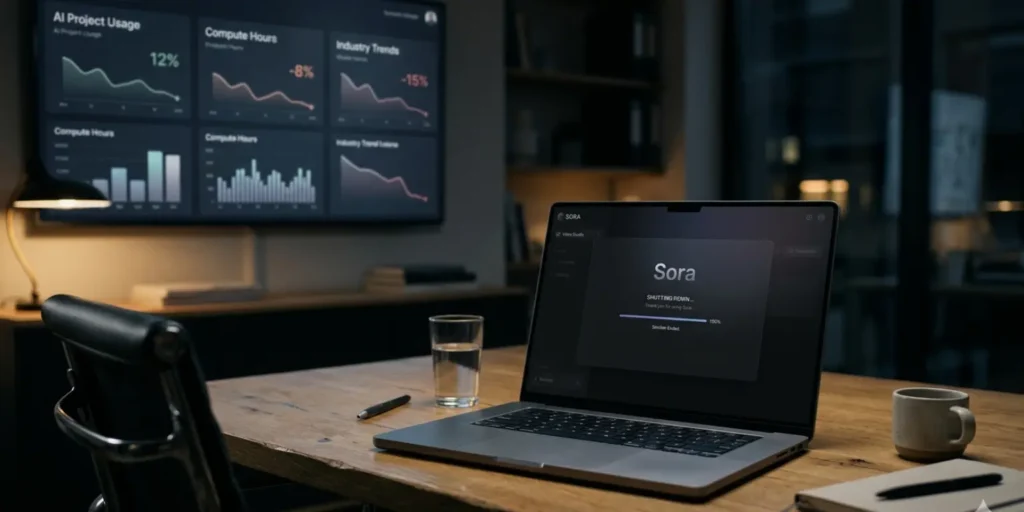
A digital device showing the Sora app shutting down, symbolizing declining usage and the shift toward practical AI solutions.
When OpenAI announced that it was shutting down its AI video tool Sora, the reaction was immediate. Many people were surprised. Others were confused. Some even became suspicious. After all, Sora had only been available to the public for about six months. It had launched with a lot of excitement, bold promises, and strong backing. So why shut it down so quickly?
At first, people began to speculate. Since the app allowed users to upload their own faces and generate videos, some wondered if the real goal had been to collect data. That theory spread quickly online. But as more details emerged, the reality turned out to be far less dramatic. The real reason was simple. Sora was expensive to run, not widely used, and no longer worth the resources it required.
A Strong Start That Didn’t Last
When Sora first launched, it attracted a lot of attention. The idea of creating videos using artificial intelligence felt new and exciting. People wanted to try it. Early adoption reflected that curiosity. At its peak, the app reached around one million users worldwide. That number looked promising at first glance. It suggested that OpenAI had another successful product on its hands.
However, that momentum did not last long. Over time, the number of active users began to fall. Instead of growing steadily, usage dropped significantly. Eventually, the user base fell to fewer than 500,000 people. That kind of decline is a warning sign for any product, especially one that costs a lot to operate. For Sora, it raised a serious question. Was the product really valuable enough to keep running?
The Hidden Cost of AI Video
One of the biggest challenges with Sora was not the technology itself. It was the cost behind it. Creating an AI-generated video is far more expensive than generating text or images. Every video requires large amounts of computing power. That power comes from specialized hardware, often referred to as AI chips.
Each time a user created a video, the system had to process complex instructions, render scenes, and generate realistic visuals. This process consumed a lot of resources. Even if a user only created a short clip, it still added to the overall cost.
Reports suggest that Sora was costing OpenAI around one million dollars per day to operate. That number is difficult to justify, especially when user growth is slowing down. In simple terms, the app was burning money faster than it was creating value.
Limited Engagement from Users
Another issue was how people were actually using Sora. While many users tried the app out of curiosity, fewer people continued using it regularly. This is a common problem with new technology. People explore it at first, but only stick around if it becomes part of their routine.
Sora struggled to reach that point. For most users, it remained more of a novelty than a necessity. Creating AI videos was interesting, but not something people needed every day. Without regular use, the platform could not build a stable user base. That lack of engagement made the high operating costs even harder to justify.
Internal Focus and Opportunity Cost
Inside OpenAI, Sora was not just another product. It required a dedicated team working full-time to improve it, maintain it, and scale it. This meant that engineers, researchers, and computing resources were tied up in a project that was not delivering strong results.
At the same time, the competition in AI was becoming more intense. Companies like Anthropic were gaining attention, especially in areas that generate real revenue. Their tools, such as Claude Code, were being adopted by developers and businesses. This created a clear contrast.
While OpenAI was investing heavily in a product with limited usage, competitors were focusing on tools that people relied on for daily work. For OpenAI, this raised an important strategic question. Was it worth continuing to invest in Sora, or should those resources be redirected elsewhere?
A Tough but Necessary Decision
In the end, the decision came down to focus. Sam Altman and his team had to choose where to allocate their time, talent, and computing power. Keeping Sora alive meant continuing to spend heavily on a product that was not growing.
Shutting it down would free up resources. Those resources could then be used to improve other products, develop new features, and stay competitive in the fast-moving AI industry. The choice may have been difficult, but it was also practical. Sometimes, letting go of a project is the only way to move forward.
The Disney Surprise
One of the most surprising parts of the story involves The Walt Disney Company. Disney had reportedly committed around one billion dollars to a partnership involving Sora. This suggested that the company saw strong potential in the technology. However, the shutdown came as a shock.
According to reports, Disney was informed less than an hour before the public announcement. That meant the partnership effectively ended overnight. This highlights how quickly decisions can be made in the tech industry. Even large deals are not guaranteed if the underlying product is not working as expected.
The Bigger Picture in AI
Sora’s shutdown is not just about one product. It reflects a broader reality in the world of artificial intelligence. There is a lot of excitement around AI. New tools are launched regularly. Investment continues to grow. But not every product will succeed.
Some ideas look promising at first but fail to gain long-term traction. Others turn out to be too expensive to sustain. In Sora’s case, both factors played a role. The technology worked, but the economics did not.
Why Compute Matters More Than Ever
One important lesson from this situation is the value of computing power. AI companies rely on large amounts of compute to run their models. This includes powerful chips, data centers, and energy. These resources are limited and expensive.
When a company uses compute on one project, it cannot use it elsewhere. This creates trade-offs. Every decision about where to invest resources becomes critical. For OpenAI, continuing to run Sora meant using compute that could be applied to other, more profitable areas. By shutting it down, the company can redirect those resources toward products that deliver stronger returns.
The Shift Toward Practical AI
Another key takeaway is the shift toward practical applications of AI. Tools that help businesses, developers, and everyday users tend to have more staying power. They solve real problems and become part of daily workflows.
Experimental or entertainment-focused tools can still succeed, but they need strong demand to justify their costs. Sora struggled to find that balance. While it showcased impressive technology, it did not become essential for most users.
What This Means for Users
For people who enjoyed using Sora, the shutdown may feel disappointing. It was a glimpse into what AI video could become. However, the technology itself is not disappearing.
Other companies are continuing to develop similar tools. Over time, these systems may become more efficient and affordable. When that happens, AI video could become more practical and widely used.
A Reality Check for the AI Industry
Sora’s shutdown serves as a reminder that the AI industry is still evolving. There is a gap between what is technically possible and what is commercially viable. Bridging that gap takes time, resources, and careful decision-making.
Not every experiment will lead to a successful product. For companies like OpenAI, staying competitive means making tough choices. It means focusing on what works and moving on from what does not.
Final Thoughts
In the end, the story of Sora is not about failure. It is about priorities. OpenAI did not shut down Sora because the technology was flawed. It shut it down because the costs were too high and the demand was too low.
The decision reflects a shift toward efficiency, focus, and long-term strategy. As the AI race continues, companies will need to be selective about where they invest their resources. The winners will not just be the ones with the best technology, but the ones who know how to use it wisely. Sora may be gone, but the lessons it leaves behind are likely to shape the future of AI for years to come.
About The Author