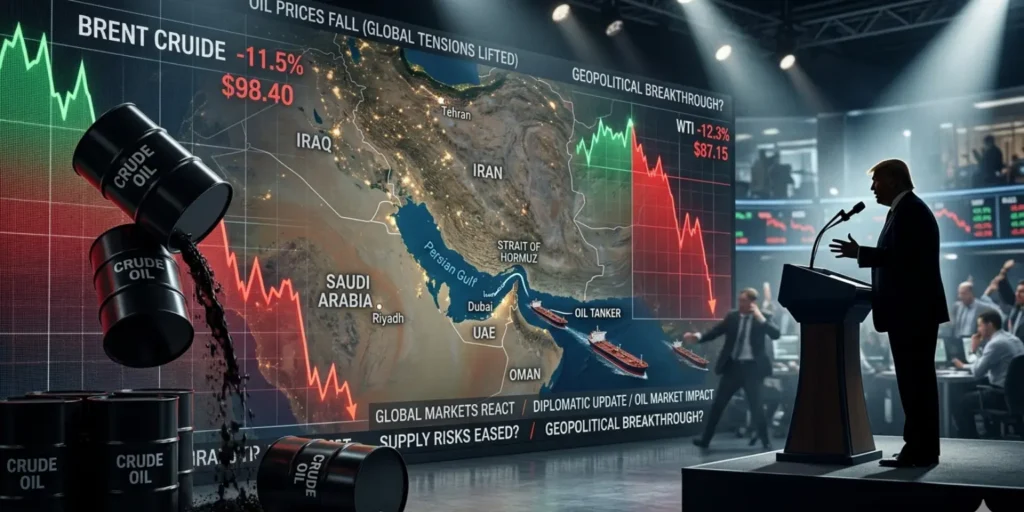
Oil markets fall as Donald Trump hints at Iran negotiations, easing global supply concerns.
Global oil markets saw a sharp pullback after Donald Trump suggested that negotiations to end the ongoing conflict with Iran were progressing. His remarks, which hinted at a possible diplomatic breakthrough, eased investor fears—at least temporarily—about prolonged disruptions to global energy supplies.
Oil Markets React Quickly
Following Trump’s comments, benchmark crude prices dropped significantly. Brent crude fell by around 5% to $99.29 per barrel, while West Texas Intermediate declined more than 5.5% to $88.41.
This sudden decline reflects how sensitive oil markets are to geopolitical developments. Even the suggestion of peace talks can shift sentiment, particularly when tensions involve critical energy corridors.
However, the situation remains highly uncertain. While Trump claimed that discussions were actively taking place and that counterparts “want to make a deal,” officials in Tehran strongly denied these assertions.
Iran Pushes Back on US Claims
Iranian authorities dismissed the idea of ongoing negotiations as “fake news,” signaling deep mistrust between the two sides. Officials questioned the credibility of US diplomacy, especially given the ongoing military conflict.
Statements from Iranian representatives highlighted skepticism about Washington’s intentions, suggesting that any claims of mediation or peace efforts should be viewed cautiously. This sharp contrast in narratives underscores the fragile and volatile nature of the situation.
Strategic Importance of the Strait of Hormuz
Despite the conflicting claims, one development offered some reassurance to markets. Iran indicated that “non-hostile” vessels could safely pass through the Strait of Hormuz—a critical chokepoint through which roughly 20% of the world’s oil and liquefied natural gas flows daily.
This statement helped ease fears of a complete blockade, which would have had severe consequences for global energy supply. However, access remains conditional, with vessels required to comply with Iranian regulations and avoid any involvement in hostile activities.
The Strait’s stability is central to global energy security. Any disruption there can quickly ripple across international markets, driving up prices and increasing volatility.
Ongoing Conflict Keeps Risks Alive
Even as oil prices fell, the broader geopolitical situation remains tense. Military exchanges between Iran and Israel continue, with reports of missile strikes and ongoing military operations.
These developments highlight the gap between diplomatic rhetoric and on-the-ground reality. While markets may respond positively to the prospect of negotiations, the continuation of hostilities suggests that a resolution is far from certain.
Global Markets Show Signs of Relief
The easing of oil prices had an immediate impact on global financial markets. Major indices across the Asia-Pacific region moved higher as investors welcomed the reduced risk of prolonged supply disruptions.
Countries like Japan and South Korea, which rely heavily on oil imports passing through the Strait of Hormuz, saw notable gains in their stock markets. This reflects how closely tied equity performance can be to energy price stability. The market reaction suggests that investors are cautiously optimistic—but not fully convinced—that tensions will ease.
Energy Prices Still Elevated
Despite the recent drop, oil prices remain significantly higher than pre-conflict levels. Since the outbreak of hostilities, energy markets have experienced sharp increases due to fears of supply constraints.
The temporary easing does not eliminate the underlying risks. Analysts warn that prices could quickly rise again if negotiations fail or if disruptions to shipping routes intensify.
Economic Implications and Recession Risks
The stakes extend far beyond energy markets. Rising oil prices have broader economic consequences, affecting inflation, consumer spending, and global growth.
Larry Fink has warned that if oil prices climb to $150 per barrel, it could trigger a global recession. High energy costs would strain economies worldwide, particularly those heavily dependent on imports.
Similarly, executives in the energy sector have cautioned about potential shortages. Shell CEO Wael Sawan indicated that Europe could face supply challenges in the near future if disruptions persist.
Governments and Businesses on Alert
In response to rising energy costs, governments around the world have begun implementing measures to cushion the economic impact. These include subsidies, strategic reserve releases, and policy adjustments aimed at stabilizing markets.
Businesses, particularly in transportation and manufacturing, are also feeling the pressure. Higher fuel costs translate directly into increased operating expenses, which can ultimately be passed on to consumers.
The Role of Market Sentiment
One of the key takeaways from the recent price drop is the power of market sentiment. Oil prices are not driven solely by physical supply and demand—they are also heavily influenced by expectations. Trump’s comments, despite being disputed, were enough to shift perceptions about the likelihood of a prolonged conflict. This demonstrates how quickly markets can move based on narrative and speculation.
However, as analysts point out, sustained price stability will require more than optimistic statements. Concrete developments—such as verified negotiations or guaranteed safe passage through critical routes—will be necessary to maintain confidence.
A Fragile Balance
The current situation represents a delicate balance between hope and uncertainty. On one hand, the possibility of negotiations offers a pathway to de-escalation. On the other hand, ongoing military activity and conflicting narratives keep risks elevated. Energy markets will continue to react to every new development, with prices likely to remain volatile in the near term.
Conclusion
The recent drop in oil prices following comments by Donald Trump highlights the sensitivity of global markets to geopolitical signals. While the prospect of peace talks has provided temporary relief, the broader conflict involving Iran and Israel remains unresolved.
The reopening—albeit conditional—of the Strait of Hormuz has helped ease immediate concerns, but the situation is far from stable. For now, markets are cautiously optimistic. But until there is clear and credible progress toward peace, oil prices—and the global economy—will remain vulnerable to sudden shifts.
About The Author