
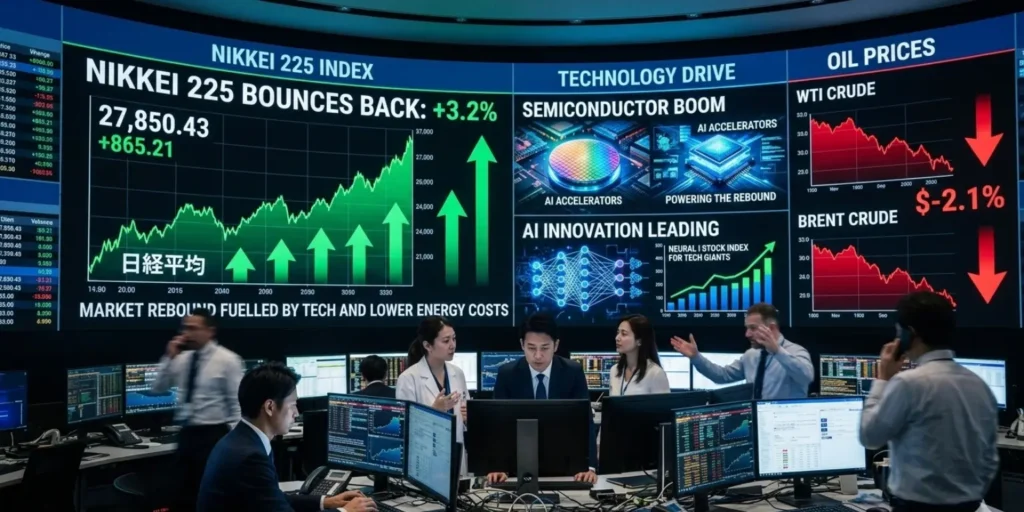
Japanese stocks rise as technology and semiconductor companies lead the Nikkei 225 rebound after oil prices decline.
Japanese stocks staged a strong rebound as investor sentiment improved following a sharp drop in oil prices and reassuring comments from Donald Trump about the conflict in the Middle East. The recovery lifted the Nikkei 225 after a difficult trading session earlier in the week, when global markets experienced a broad selloff driven by geopolitical tensions and rising energy costs. Investors returned to technology and export-related stocks as falling oil prices eased inflation concerns and improved expectations for economic stability in international markets.
The rebound in Japan’s equity market reflects how closely financial markets are responding to developments in global politics and energy prices. Lower oil prices helped ease fears of prolonged inflation and economic disruption, encouraging investors to return to risk assets.
Japanese Markets Recover From Monday’s Selloff
The benchmark Nikkei 225 index rose sharply during morning trading in Tokyo, climbing as much as 3.6% by 10:30 a.m. local time. The broader Topix index also posted strong gains, advancing up to 3%. This rally came after a significant drop the previous day, when investors reacted to escalating geopolitical tensions in the Middle East and fears of disruptions to global oil supply.
Monday’s market downturn had been triggered by concerns that the conflict involving Iran could intensify and potentially disrupt the global energy market. Those fears led to a surge in oil prices and a sharp decline in global equity markets. However, Tuesday’s decline in oil prices and optimistic remarks from political leaders helped restore confidence among investors.
Technology and AI Stocks Lead the Rally
Technology companies played a major role in driving the Japanese market rebound. Shares of semiconductor and artificial intelligence-related firms surged as investors returned to growth sectors.
Among the biggest gainers were:
- Lasertec Corp.
- Ibiden Co.
- Sumitomo Electric Industries
These companies are closely linked to the global semiconductor supply chain and the expanding demand for artificial intelligence hardware. Semiconductor equipment makers like Lasertec are particularly sensitive to shifts in global technology investment. When investor confidence improves, these stocks often experience significant price increases.
The AI sector has remained one of the strongest drivers of equity market performance worldwide. Demand for advanced computing hardware continues to rise as companies expand their artificial intelligence capabilities.
Banks and Industrial Firms Also Advance
In addition to technology companies, other sectors of the Japanese economy also saw strong gains. Banking stocks moved higher as improving market sentiment encouraged investors to shift back toward cyclical industries. Rising bond yields and expectations for stable economic conditions can also support financial sector profits.
Machinery manufacturers, another important component of Japan’s export-driven economy, also advanced during the trading session. These companies often benefit when global growth expectations improve, since demand for industrial equipment typically rises during economic expansions.
Oil Price Decline Eases Market Concerns
One of the key drivers behind the rebound in Japanese stocks was a significant drop in oil prices. Energy markets had surged earlier in the week after fears that the conflict involving Iran could disrupt shipments through the critical Strait of Hormuz.
The strait is one of the world’s most important energy shipping routes, with a large portion of global oil exports passing through the narrow waterway. Any disruption to this route can quickly cause oil prices to spike, raising costs for businesses and consumers around the world.
However, oil prices declined sharply after political signals suggested the conflict might not escalate further. The drop in crude prices helped reduce inflation fears and improved sentiment across financial markets. Lower energy costs are particularly beneficial for Japan because the country imports most of its oil and natural gas. When oil prices rise, Japanese businesses face higher operating costs, and consumers experience increased fuel and electricity prices. Therefore, a decline in oil prices often provides immediate support to Japanese equities.
Trump’s Comments Calm Investor Fears
Investor sentiment also improved after remarks from Donald Trump suggesting that tensions in the Middle East could ease soon. Trump indicated that the conflict might be resolved in the near future, which helped reduce fears of a prolonged military confrontation.
Geopolitical uncertainty is one of the biggest factors affecting financial markets. When conflicts appear likely to escalate, investors often move money into safer assets such as government bonds or gold. Conversely, when tensions appear to ease, investors typically return to equities and other higher-risk investments. Trump’s comments therefore, helped encourage the market rebound seen in Japan and other global markets.
Global Tech Demand Supports Japanese Stocks
Japan’s technology sector plays a critical role in the global electronics and semiconductor supply chain. Companies like Ibiden Co. produce advanced packaging materials used in high-performance chips, while Sumitomo Electric Industries manufactures specialized components used in electronics, telecommunications, and automotive technology.
Meanwhile, Lasertec Corp. supplies inspection equipment essential for advanced semiconductor manufacturing. As artificial intelligence, cloud computing, and data center expansion continue to grow worldwide, demand for these technologies has increased significantly. This global technology boom has helped support Japanese semiconductor and electronics companies, making them key beneficiaries of the ongoing AI revolution.
Market Volatility Remains High
Despite the strong rebound, analysts caution that markets remain highly volatile due to ongoing geopolitical risks. The conflict involving Iran and its potential impact on global energy supply remains a major source of uncertainty for investors. Even small developments in the situation can cause rapid price movements in oil, currencies, and equity markets.
Additionally, global investors continue to monitor inflation trends and central bank policies. Rising energy prices could still create inflationary pressure if oil markets become unstable again. Such developments could influence interest rate decisions by major central banks and affect global financial conditions.
Outlook for Japanese Markets
Looking ahead, Japanese stocks may continue to benefit from several supportive factors. First, strong demand for semiconductors and AI technologies is expected to support many of the country’s leading technology companies. Second, any sustained decline in oil prices would reduce economic pressure on Japan’s import-dependent economy.
Finally, global investor interest in Asian markets has been increasing as companies in the region expand their roles in technology manufacturing and supply chains. However, geopolitical developments in the Middle East and fluctuations in energy markets will likely remain key drivers of market sentiment. For now, the sharp rebound in the Nikkei 225 and Topix shows that investors are willing to return to equities when signs of stability emerge—even if uncertainty still lingers in the global economy.
About The Author