
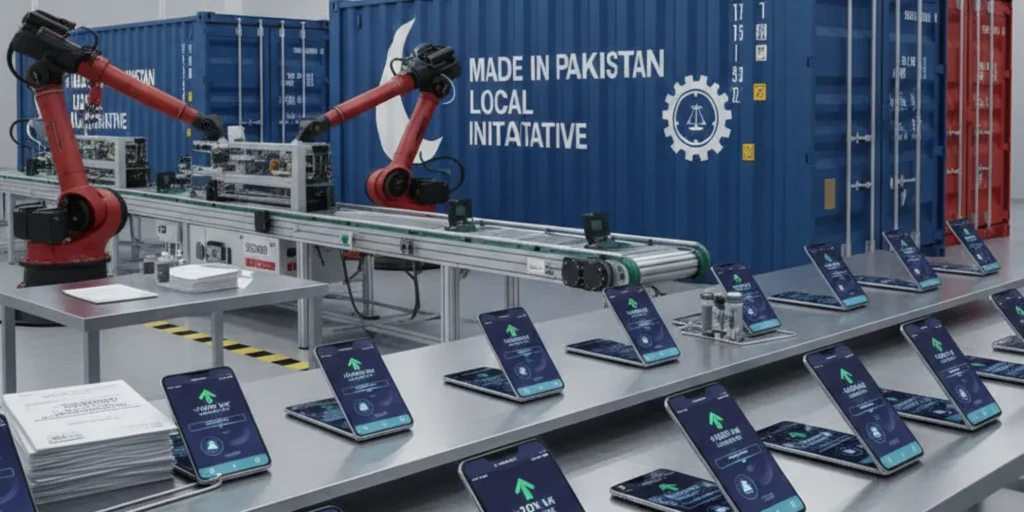
Pakistan plans new excise and customs duties on imported mobile phones as part of a broader push to boost local electronics manufacturing and refurbished device exports.
The government is considering new taxes on imported mobile phones as part of a broader plan to strengthen local manufacturing and boost exports of refurbished electronic devices. The proposed measures are part of a new Mobile and Electronics Manufacturing Framework that is close to receiving final approval.
Officials say the policy aims to balance trade, reduce reliance on imports, and position Pakistan as a regional hub for mobile and electronics manufacturing.
Focus on Refurbished Mobile Re-Exports
A key target of the new framework is to generate up to $400 million annually through the re-export of refurbished mobile phones. The plan is being led by the Engineering Development Board, which has completed the framework and submitted it to the Ministry of Industries and Production.
The ministry is expected to forward the proposal to Shehbaz Sharif for final approval in the coming weeks. Officials believe refurbished mobile phones and laptops offer a strong export opportunity if the right infrastructure and regulatory controls are put in place.
Proposed Excise Duty on Imported Mobiles
Sources familiar with the policy say the government is planning to impose a 20 percent federal excise duty on the completely built unit structure of new mobile phones. At present, no excise duty is applied to such imports.
The move is intended to address competitive challenges created under the Pakistan-China Free Trade Agreement, which has made imported devices cheaper and harder for local manufacturers to compete with. In addition to mobile phones, the government plans to impose a 10 percent customs duty on imported notebooks, desktops, and tablets that arrive as fully assembled units.
Gradual Duties on Semi-Assembled Devices
The proposed policy also introduces duties on completely knocked down structures used for local assembly. Initially, a 5 percent customs duty will be applied, which will later be increased to 10 percent.
Officials say this gradual increase is meant to give local manufacturers time to adjust while encouraging deeper localisation over the coming years. The goal is to shift from simple assembly toward full-scale manufacturing, including components and parts.
Dedicated Zones for Refurbishment and Export
To support refurbished device exports, the government plans to create a dedicated refurbishment-for-re-export regime within export processing zones. Under this plan, around one acre of gated space may be allocated for investors to set up refurbishment facilities.
These zones will operate under strict customs supervision to prevent refurbished devices from entering the domestic market. According to estimates, between 30 and 40 million mobile phones could be refurbished and exported each year. This could generate export earnings ranging from $300 million to $400 million annually.
Two Import Models Under Consideration
The framework outlines two possible models for importing used devices for refurbishment and re-export. Under the first model, devices would be imported temporarily for processing and re-export without foreign exchange remittance at the import stage.
This arrangement would be backed by service agreements and secured through bank guarantees. All goods would remain in bonded facilities under customs control. Mandatory IMEI declaration, IMEI blocking, and time-bound re-export rules would be enforced to ensure no leakage into the local market.
Commercial Imports With Strict Controls
The second model allows imports on a regular commercial basis with full foreign exchange remittance through letters of credit or contracts. These imports would also operate under bonded or export facilitation schemes. Strict inventory tracking, IMEI controls, and export realisation requirements would apply to ensure compliance. Officials say both models are designed to attract investment while protecting the local market from misuse.
Policy Reviewed at High-Level Meeting
The Mobile and Electronic Devices Manufacturing Policy 2026–33 was recently reviewed at a high-level meeting chaired by Special Assistant to the Prime Minister Haroon Akhtar Khan.
The meeting was attended by senior officials, including the federal secretary for industries and production and the chief executive of the Engineering Development Board. After detailed discussions, the policy was finalised and cleared for submission to the prime minister.
Government Eyes Local Manufacturing Push
Speaking at the meeting, Akhtar Khan said Pakistan would formally begin large-scale local manufacturing of mobile phones and electronic devices in line with the prime minister’s vision.
He described the policy as a milestone for the industrial sector, stating that it would strengthen the manufacturing base and significantly increase exports. He also said that global companies such as Apple and Samsung would be invited to set up manufacturing plants in Pakistan.
Jobs, Investment, and Technology Transfer
Officials believe the new policy will lead to job creation, technology transfer, and increased foreign investment. A Rs56 billion technology investment fund is also planned to support local production of mobile phones and other electronic devices.
The policy recommends creating a dedicated Mobile and Electronics Devices Cell within the Engineering Development Board to oversee implementation and coordination.
Long-Term Vision for Electronics Exports
The final framework reflects the government’s focus on industrial modernisation and export-led growth. By encouraging refurbishment, local assembly, and manufacturing, Pakistan hopes to become a competitive player in the global electronics value chain.
If approved, the policy could reshape the country’s mobile phone market and reduce dependence on imports while opening new export channels.
About The Author