
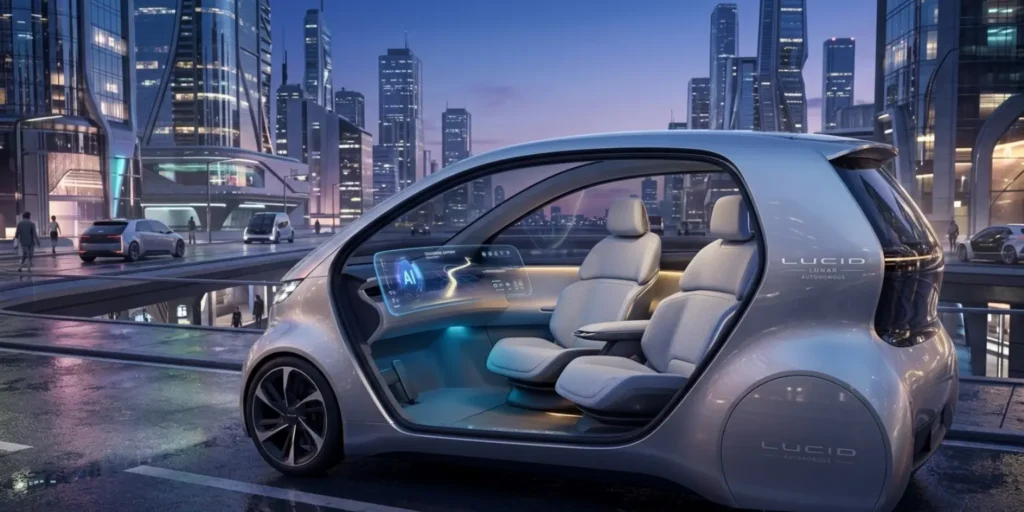
Lucid Motors unveils the Lunar robotaxi concept, a fully autonomous two-seater EV showcasing the company’s vision for future mobility services.
Lucid Motors has introduced a new robotaxi concept called “Lucid Lunar” at its investor day in New York City. The vehicle is a two-seater designed without a steering wheel or pedals, signaling Lucid’s vision of a fully autonomous ride. The company says Lunar shares its platform with Lucid’s upcoming mid-size electric vehicles, making it easier to adapt existing technology to autonomy.
The Lunar concept is intended to highlight Lucid’s long-term ambitions rather than signal an immediate product launch. Interim CEO Marc Winterhoff mentioned that the company is “working on” Lunar, but later clarified that dedicated development for the robotaxi has not yet begun. The concept provides investors and the public with a glimpse of Lucid’s autonomous vision.
The unveiling reflects the company’s broader focus on integrating autonomy into its business. Lucid is exploring ways for robotaxis to complement its electric vehicle sales, signaling a strategic shift from solely selling vehicles to also participating in future mobility services. While Lunar is still conceptual, it positions Lucid as a serious contender in the emerging autonomous transport market.
Partnership Plans With Uber and Nuro
Lucid Motors is actively pursuing partnerships to bring autonomous vehicles to real-world ride-hailing services. The company said it is close to an agreement with Uber to create a robotaxi using one of its mid-size vehicle models. While details remain confidential, this collaboration could significantly expand Lucid’s revenue opportunities beyond direct vehicle sales.
Additionally, Lucid is working with autonomous vehicle company Nuro to develop a self-driving version of its Gravity SUV for Uber’s network. The plan is for these autonomous vehicles to launch by the end of 2026 in the San Francisco area. Lucid has not confirmed whether Nuro’s proprietary autonomous technology will be fully integrated into this new vehicle.
These partnerships illustrate Lucid’s strategy to leverage its electric vehicle platforms for broader autonomous mobility services. By collaborating with established players like Uber and Nuro, Lucid can accelerate adoption and gain practical experience deploying autonomous vehicles in urban environments, without bearing the full development cost alone.
Focus on Autonomous Revenue Streams
During its investor day, Lucid highlighted how autonomy could become a key revenue driver. A chart displayed during the event suggested that robotaxi partnership income could eventually surpass revenue from licensing Lucid’s EV technology. While the chart lacked specific numbers, it reinforced the company’s view that autonomous services could dominate future earnings.
The company is also preparing to monetize its semi-autonomous systems. Lucid plans to offer subscription-based packages for its DreamDrive Pro technology, allowing customers to pay monthly for increasing levels of driver assistance. The entry-level subscription will cost $69 per month, with the top-tier plan reaching $199 per month for fully autonomous capability, still under development.
This subscription model mirrors approaches taken by companies like Tesla with Full Self-Driving and Rivian with its autonomy-focused software. Lucid sees software monetization as its “single biggest opportunity,” emphasizing that recurring revenue from autonomous driving features could become a cornerstone of its business strategy.
DreamDrive Pro Subscriptions and Monetization
Lucid’s DreamDrive Pro system is designed to provide scalable autonomy, allowing owners to pay based on the level of driver assistance they want. Subscriptions will start in early 2027, offering incremental upgrades as new capabilities are added. The system represents an effort to shift the company from a traditional vehicle manufacturer to a recurring revenue model.
Currently, the company does not offer fully autonomous functionality, and no automaker has yet developed a system capable of full hands-free driving in all conditions. Despite this, Lucid is positioning itself to capitalize on the demand for advanced driver assistance and autonomous software, preparing the ground for future upgrades that could increase profitability.
The subscription model also encourages customer retention and engagement. By continuously updating software capabilities, Lucid can keep drivers invested in its ecosystem. Recurring subscriptions provide a predictable revenue stream and allow the company to continuously improve and refine its autonomous technologies without requiring additional hardware purchases.
Lunar’s Place in Lucid’s EV Portfolio
Lunar is built on the same platform as Lucid’s upcoming mid-size electric vehicles, indicating the company’s intention to share technology across multiple products. This platform strategy allows Lucid to leverage research and development investments across several vehicle types while maintaining cost efficiency.
The mid-size EV lineup is expected to launch first, including models like the Lucid Cosmos and Lucid Earth. Lunar will debut sometime afterward, serving as a showcase for Lucid’s autonomous capabilities while remaining compatible with existing manufacturing and supply chains. This approach ensures that the robotaxi concept does not require a completely separate development pathway.
By aligning Lunar with its mid-size platform, Lucid aims to balance innovation with practicality. Investors and consumers alike can see how the company plans to scale autonomous technologies without overcomplicating production or inflating costs, making the robotaxi a feasible future offering rather than purely conceptual.
In-Cabin AI Assistant Development
Lucid Motors is developing an in-cabin AI assistant to enhance user experience. The assistant is designed to handle routine tasks like adjusting climate controls or answering driver queries. More advanced capabilities could include suggesting unique activities or destinations, reflecting Lucid’s focus on blending AI with user-centric vehicle functionality.
During the investor day, the company attempted a live demo, which failed, highlighting the ongoing challenges of building reliable in-car AI. Instead, a pre-recorded video was shown. Despite this, Lucid’s efforts demonstrate a commitment to creating intelligent vehicle assistants that can handle increasingly complex commands in a natural, conversational way.
The AI assistant is part of a larger trend in the automotive industry, where manufacturers are integrating smart features to differentiate their vehicles. By developing its own proprietary system, Lucid seeks to provide a seamless, integrated experience for drivers while keeping software control in-house, similar to approaches used by Tesla and Rivian.
Manufacturing Efficiency and Cost Reduction
Beyond autonomy, Lucid’s event emphasized strategies to reduce manufacturing costs and improve efficiency. These efforts are crucial for making its mid-size electric vehicles more affordable, with entry prices expected to be around $50,000. Lower costs will help expand the customer base and support broader adoption of Lucid’s EVs.
The company is also working to improve drivetrain efficiency. Optimizing battery and motor performance is key to achieving competitive range and performance while keeping energy consumption and operating costs low. These technical improvements complement Lucid’s autonomy and software initiatives.
Efficient manufacturing and advanced powertrains also position Lucid to scale its operations. By controlling costs without compromising performance, the company can offer attractive pricing for mid-size vehicles while maintaining the flexibility to explore higher-margin opportunities like software subscriptions and robotaxi services.
Mid-Size EV Launch Plans
Lucid plans to introduce its mid-size vehicles by the end of 2026. The first model will be known as the Lucid Cosmos, followed by the Lucid Earth. A third model has yet to be announced. These vehicles will serve as the foundation for both traditional EV sales and potential autonomous services like Lunar.
Launching mid-size vehicles first allows Lucid to test manufacturing processes, market reception, and supply chains before introducing fully autonomous vehicles. By sequencing product launches in this way, the company can reduce risk while preparing for the more complex development of robotaxis and autonomy-based services.
These vehicles will also provide a base platform for future collaboration with partners like Uber and Nuro. Mid-size EVs offer versatility for both personal ownership and shared autonomous mobility, allowing Lucid to explore multiple revenue streams while maintaining technological consistency across its product lineup.
Competing in the Autonomous Vehicle Market
Lucid is entering a competitive autonomous mobility market that includes Tesla, Waymo, and Rivian. The company must balance ongoing EV development with efforts to build partnerships and advance software capabilities. Success will depend on both vehicle quality and the reliability of autonomous features.
Its approach of offering both partial autonomy subscriptions and eventual full robotaxi services mirrors strategies seen with Tesla’s Full Self-Driving and Rivian’s autonomy plans. Lucid hopes to capture a portion of the growing demand for driverless services while maintaining flexibility in its product offerings.
Strategic partnerships, like those with Uber and Nuro, are essential for reducing entry barriers. These collaborations provide access to real-world data, operational expertise, and existing mobility networks, allowing Lucid to accelerate its autonomous initiatives without starting entirely from scratch.
Looking Ahead: Autonomy and EV Growth
Lucid Motors is clearly signaling that autonomy will play a central role in its long-term strategy. By combining mid-size EV platforms, in-cabin AI, subscription software, and robotaxi concepts, the company aims to diversify revenue streams while preparing for the future of urban mobility.
The roadmap suggests a phased approach: launch mid-size vehicles, introduce AI-driven driver assistance, and ultimately roll out robotaxis like Lunar. Each stage builds on the previous one, enabling Lucid to test technologies, gather data, and refine capabilities before full commercial deployment.
If executed successfully, Lucid could become a significant player in both electric vehicles and autonomous mobility services. With strong investor support, ongoing partnerships, and a focus on scalable platforms, the company has positioned itself to compete in a rapidly evolving automotive landscape over the next decade.
About The Author