
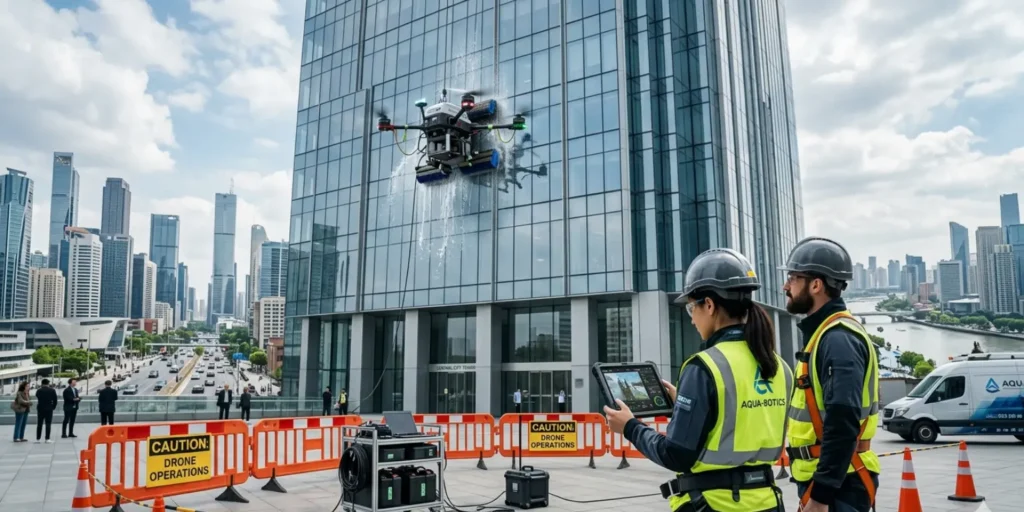
Lucid Bots uses drones and robots to make dangerous jobs like window cleaning safer and more efficient.
In an era where much of the robotics industry is focused on futuristic humanoids and flashy demonstrations, Lucid Bots is taking a very different path—one grounded in practical, real-world impact. The Charlotte, North Carolina-based startup has just raised $20 million in a Series B funding round, bringing its total funding to $34 million, as it works to meet growing demand for its window-washing drones and cleaning robots.
Founded by Andrew Ashur, the company is positioning itself as a counterpoint to the hype-driven narrative often associated with robotics today. Instead of building robots that dance or perform eye-catching stunts, Lucid Bots focuses on solving real problems—specifically, making dangerous and labor-intensive jobs safer and more efficient.
A Different Kind of Robotics Company
While many robotics companies are racing to perfect humanoid machines or experimental AI-driven systems, Lucid Bots has built its reputation on utility. Its flagship products, including Sherpa drones and Lavo cleaning robots, are already being deployed on job sites to assist cleaning companies with tasks like high-rise window washing.
Ashur himself has emphasized this distinction, noting that while others may still be in labs or simulation environments, Lucid Bots’ machines are actively working in the field. The company’s approach reflects a broader philosophy: prioritize performance over presentation. This focus has resonated with customers. Demand for Lucid Bots’ solutions has surged in recent years, highlighting a growing appetite for robotics that can deliver immediate, measurable value.
From Idea to Industry Solution
The origin of Lucid Bots is rooted in a real-world problem. Ashur came up with the idea while studying economics and Spanish at Davidson College. One day, he witnessed window washers struggling to maintain control of a swing stage on a windy day, creating a dangerous situation. That moment sparked a realization: technology could significantly improve safety in such environments.
Launched in 2018, Lucid Bots initially operated as a cleaning company. This hands-on approach allowed the team to better understand industry challenges before developing robotic solutions. After two years of field experience—and even some chemical-related injuries—they gained the insights needed to design effective products.
Slow Start, Rapid Growth
Like many startups, Lucid Bots faced early skepticism. It took five years to sell its first 100 robots, and convincing investors was not easy—especially given Ashur’s non-engineering background.
However, persistence paid off. The company’s growth has accelerated dramatically, with sales now approaching 1,000 units. This rapid increase reflects both improved product-market fit and rising demand for automation in labor-intensive industries.
The latest $20 million funding round, led by Cubit Capital and Idea Fund Partners, will be used primarily to scale operations. This includes hiring more staff and expanding manufacturing capacity to keep up with increasing customer interest.
Why Demand Is Rising
Several factors are driving demand for Lucid Bots’ technology. First, there is a growing shortage of workers willing to perform physically demanding and risky jobs like window cleaning. At the same time, infrastructure is aging, and new buildings are becoming larger and more complex to maintain. These trends create a clear need for automation.
Lucid Bots’ drones address this gap by reducing risk and improving efficiency. Instead of workers hanging from tall buildings, drones can handle tasks remotely, minimizing exposure to hazards. Additionally, the company’s products are designed to be practical and adaptable. Data collected during operations is fed back into the system, allowing continuous improvements in performance.
Expanding Beyond Cleaning
While window washing remains a core use case, Lucid Bots is already expanding into adjacent industries. The company is developing tools that enable its robots to handle tasks such as painting, waterproofing, and sealing. In one example, the company used its technology to waterproof a large university stadium—demonstrating the versatility of its platform.
Customer demand is playing a key role in this expansion. Even before actively marketing these new capabilities, Lucid Bots was receiving dozens of monthly inquiries related to painting and coating applications. This suggests that the potential market for its technology extends far beyond its original focus.
A Broader Shift in Robotics
Lucid Bots’ success highlights an important shift within the robotics industry. While cutting-edge research and experimental designs continue to capture headlines, there is growing recognition of the value of practical, task-specific automation.
Companies that can deliver real-world results—especially in industries facing labor shortages and safety challenges—are gaining traction. This approach may not be as glamorous as humanoid robots or AI-driven assistants, but it addresses immediate needs and generates tangible returns for customers.
Looking Ahead
With fresh funding and increasing demand, Lucid Bots is well-positioned for continued growth. However, scaling operations will be a key challenge. The company must expand its workforce, increase production capacity, and maintain product quality—all while continuing to innovate. If successful, Lucid Bots could play a significant role in reshaping how industries approach maintenance and infrastructure management.
More broadly, its story serves as a reminder that the future of robotics is not just about what looks impressive—it’s about what works. In a field often dominated by hype, Lucid Bots is proving that practical solutions can be just as transformative—if not more so.
About The Author