
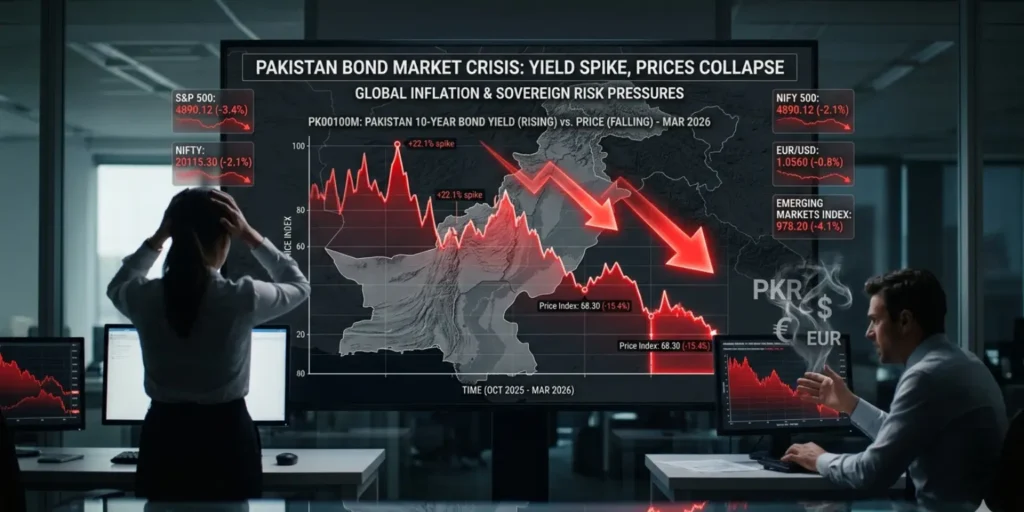
Investor panic triggers sharp capital outflows from Pakistan’s bond market amid global geopolitical tensions.
Pakistan’s financial markets are beginning to feel the ripple effects of rising geopolitical tensions in the Gulf, as foreign investors rapidly pull capital from the country’s debt market. According to data from the State Bank of Pakistan, the domestic bond market has come under noticeable pressure, with a sharp outflow of $184.3 million recorded during the first 13 days of March.
The most striking moment came on March 13, when investors withdrew $20 million in a single day—highlighting the speed at which sentiment has shifted amid growing uncertainty in global markets.
Foreign Investors Lead the Exit
The data reveals that the outflows were largely driven by international investors, with the United Kingdom leading the withdrawals at $69.5 million. Other contributors to the sell-off included Bahrain, the United States, Singapore, the United Arab Emirates, and Australia.
In contrast, inflows remained minimal, totaling just $19.3 million over the same period. These limited investments, mainly from the UK and Bahrain, were not enough to offset the heavy withdrawals, creating a clear imbalance in capital movement.
Global Tensions Drive Risk Aversion
Although Pakistan is not directly involved in the ongoing Middle East conflict, its financial markets are still exposed to global investor sentiment. Periods of geopolitical instability often trigger a “risk-off” approach, where investors move capital away from emerging markets and into safer assets.
This shift is driven less by domestic fundamentals and more by global uncertainty. Investors tend to reduce exposure to markets perceived as higher risk, even if those markets remain relatively stable internally.
Why Bond Markets Are Sensitive
Government bonds are typically considered safer than equities, but they are still vulnerable to foreign investor behavior—especially in emerging economies like Pakistan. When global tensions rise, investors often liquidate bond holdings to preserve capital or reallocate funds to more stable regions.
The sudden $20 million outflow in a single day reflects how quickly sentiment can change. It also highlights the reliance of local bond markets on foreign participation, which can amplify volatility during uncertain times.
Stability Amid Pressure
Despite the outflows, Pakistan has shown a degree of resilience. The exchange rate has remained relatively stable, and there has not yet been a significant shock from rising global oil prices.
This stability is partly supported by steady remittance inflows, particularly from overseas Pakistanis working in Gulf countries. So far, these inflows have not shown signs of disruption, suggesting that expatriate workers have not reacted strongly to the conflict.
The Role of Remittances
Remittances play a crucial role in Pakistan’s economic stability, acting as a buffer against external shocks. Continued inflows from abroad help support foreign exchange reserves and reduce pressure on the currency.
The fact that remittances remain steady is an encouraging sign. It indicates that, despite geopolitical tensions, the financial link between overseas workers and the domestic economy remains intact—for now.
Risks of Prolonged Conflict
Analysts caution that the situation could worsen if the conflict in the Gulf persists. A prolonged crisis could lead to several challenges:
- Increased global risk aversion, leading to further capital outflows
- Rising oil prices, which would strain Pakistan’s import bill
- Potential disruption to remittance flows if economic conditions in the Gulf deteriorate
These factors could combine to put additional pressure on Pakistan’s financial system, particularly if investor confidence continues to weaken.
Investor Sentiment: The Key Driver
At its core, the recent outflow reflects a shift in investor sentiment rather than a fundamental deterioration in Pakistan’s economy. Markets are reacting to uncertainty, not necessarily to domestic weaknesses.
This distinction is important. If global conditions stabilize, investor confidence could return just as quickly as it faded. However, if uncertainty persists, the outflows may continue, creating longer-term challenges for the bond market.
A Broader Emerging Market Trend
Pakistan is not alone in facing these pressures. Emerging markets around the world often experience similar capital movements during periods of global instability. Investors tend to adopt a cautious approach, prioritizing liquidity and safety over higher returns.
This pattern underscores the interconnected nature of global finance. Events in one region—such as the Middle East—can have far-reaching effects on markets thousands of miles away.
Policy Implications
For policymakers, the recent outflows highlight the importance of maintaining economic stability and investor confidence. Measures such as prudent fiscal management, stable monetary policy, and transparent communication can help mitigate the impact of external shocks.
The role of the State Bank of Pakistan will be particularly critical in navigating this period. Ensuring liquidity in the bond market and maintaining currency stability will be key priorities.
Looking Ahead
The outlook for Pakistan’s bond market will largely depend on how the geopolitical situation evolves. If tensions ease, investor sentiment could improve, leading to a reversal of recent outflows. However, if uncertainty continues, markets may remain under pressure.
For now, the situation serves as a reminder of how quickly global events can influence local economies. Even countries not directly involved in a conflict can feel its financial impact through shifts in investor behavior.
Conclusion
The $20 million single-day outflow from Pakistan’s bond market is a clear sign of rising investor caution in response to global uncertainty. While the country’s economic fundamentals remain relatively stable, external factors are driving short-term volatility.
With steady remittances providing some support, Pakistan has managed to avoid more severe disruptions. However, the path ahead will depend on both global developments and domestic resilience. As markets continue to monitor the evolving situation, one thing is certain: in an interconnected financial world, no economy is entirely insulated from geopolitical shocks.
About The Author