
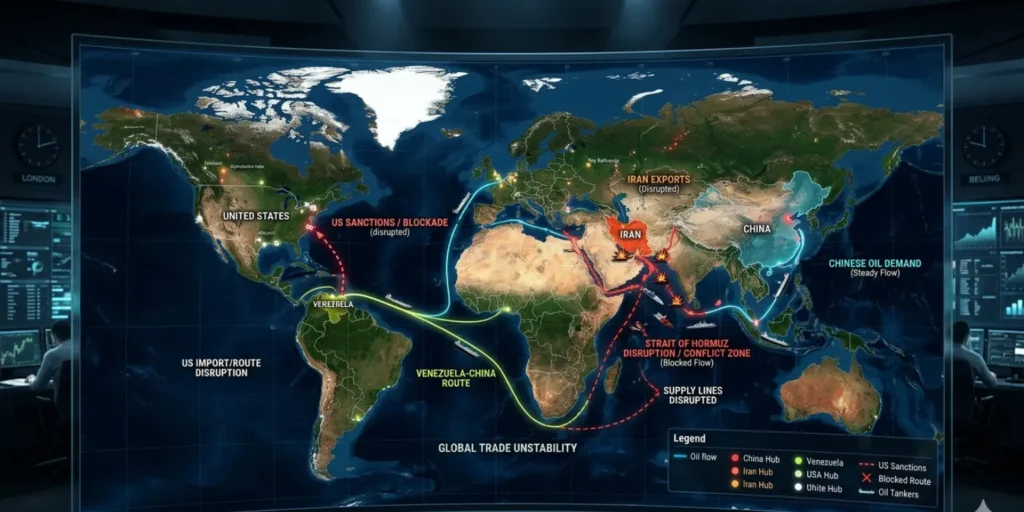
A geopolitical map showing disrupted oil supply routes from Iran and Venezuela to China, illustrating shifting global energy dynamics.
In the opening months of 2026, a series of rapid geopolitical developments reshaped the global energy landscape in ways that are still being fully understood. What appeared on the surface as isolated political and military events — instability in Venezuela and escalating conflict involving Iran — may, when viewed collectively, signal a broader strategic shift.
Within roughly sixty days, two of China’s most important alternative oil supply channels faced significant disruption. The implications of this are profound, not only for global energy markets but also for the evolving balance of power between the United States and China. This is not merely about oil. It is about leverage, industrial capacity, and the future of technological dominance.
A Rapidly Changing Timeline
The turning point began in January 2026, when Venezuela entered a new phase of political transition. Years of economic collapse, declining oil output, and mounting international pressure culminated in a shift that placed the country’s vast energy resources into a more uncertain — and externally influenced — position.
Venezuela holds the largest proven oil reserves in the world, estimated at over 300 billion barrels. For years, China had secured access to these reserves through loans-for-oil agreements, effectively locking in long-term supply. With political change underway, however, the continuity of those arrangements has been called into question.
Then came February 2026, when military escalation involving Iran disrupted critical infrastructure tied to its oil export system. Iran had developed a complex network to maintain oil flows despite sanctions, much of it directed toward China. A significant portion of these exports — estimated at over a million barrels per day — relied on logistical systems that are highly sensitive to instability.
By March 2026, both supply channels were under strain. The result was not a complete shutdown, but a significant increase in uncertainty, friction, and cost — enough to alter market behavior and strategic calculations.
China’s Structural Energy Vulnerability
To understand why this matters, one must look at China’s energy profile. Unlike the United States, which has achieved near energy self-sufficiency through shale production, China depends heavily on imports. Roughly 70% of its oil consumption comes from abroad. This dependency underpins nearly every aspect of its economy — from manufacturing to transportation to military operations.
China has spent decades building a diversified supply network to mitigate this vulnerability. Part of that strategy involved forming close ties with countries outside the Western financial system, including Iran and Venezuela. These partnerships allowed China to secure discounted oil while reducing reliance on traditional, dollar-based energy markets.
However, such a system depends on stability — not necessarily political stability, but operational continuity. When that continuity is disrupted, the entire structure becomes fragile.
The Scale of the Disruption
Combined, Iran and Venezuela have represented a meaningful portion of China’s oil imports. Estimates suggest that together they have supplied between 15% and 20% of China’s external crude needs in recent years.
While China has built strategic petroleum reserves, reportedly adding hundreds of millions of barrels in recent years, these reserves are designed as a temporary buffer — not a long-term replacement for a steady supply.
Even under optimistic assumptions, such reserves provide only a limited window of adjustment. They buy time, but they do not solve the underlying challenge: replacing large volumes of oil in a constrained and competitive global market.
Market Signals: A Structural Shift
Energy markets have already begun to reflect this new reality. Oil prices surged above $100 per barrel following the escalation involving Iran, and while volatility remains, the broader trend suggests a structural repricing of risk rather than a temporary spike. Buyers are increasingly prioritizing reliability and proximity over cost, leading to tighter markets in regions like the Mediterranean and the Atlantic Basin.
Producers in the Middle East, the United States, and parts of Africa are seeing increased demand, particularly from Asian buyers seeking to diversify away from disrupted supply channels. At the same time, shipping costs, insurance premiums, and logistical risks have all risen, adding layers of complexity to global energy trade.
The Overlooked Dimension: Energy and AI
Perhaps the most underappreciated aspect of this shift is its connection to artificial intelligence. The global AI race is fundamentally tied to energy. Training advanced models, operating data centers, and supporting digital infrastructure all require vast and reliable power supplies. Countries that can secure consistent energy access gain a significant advantage.
The United States, with its domestic energy resources and expanding data center infrastructure, is well-positioned in this regard. Regions like Texas and Arizona are emerging as hubs for AI development, supported by a stable energy supply.
China, by contrast, must balance its growing energy needs with external dependencies. Any disruption in oil supply can ripple through its industrial base, potentially affecting everything from manufacturing output to technological investment. In this sense, energy security and technological leadership are increasingly intertwined.
Winners and Losers in the New Landscape
The shifting dynamics create clear, though complex, winners and losers. The United States gains strategic leverage by operating from a position of energy strength. Its ability to influence global supply conditions enhances its geopolitical flexibility.
Middle Eastern producers, particularly those with stable output and strong export capacity, benefit from increased demand and higher prices. Their role as reliable suppliers becomes even more valuable. Russia, despite facing its own challenges, retains a unique position due to its overland energy links with China. These routes are less vulnerable to maritime disruption, making them strategically important.
China, meanwhile, faces a more constrained environment. While it retains significant economic and diplomatic tools, its energy vulnerability becomes more pronounced under pressure. Iran and Venezuela, despite their resource wealth, remain limited by political instability, infrastructure challenges, and external constraints.
Possible Paths Forward
Several scenarios could shape the next phase of this geopolitical shift.
1. Managed Adjustment
China could increase imports from alternative suppliers such as Iraq, the UAE, and West Africa. This would likely come at higher costs, impacting industrial margins but maintaining supply continuity.
2. Strategic Escalation
In a more confrontational scenario, tensions could extend into other domains, including trade, technology, or regional security. This would increase volatility across global markets.
3. Negotiated Stability
There is also the possibility of diplomatic engagement leading to a recalibration of relationships. Energy access could become a bargaining tool in broader negotiations involving trade, technology, or security issues.
Each scenario carries different implications for investors, policymakers, and global markets.
Key Indicators to Watch
To understand how this situation evolves, several indicators will be critical:
- China’s strategic reserve levels: Rapid drawdowns would signal sustained supply pressure.
- Oil price differentials: Shifts between regional benchmarks can reveal changing trade patterns.
- Shipping and insurance costs: Rising costs indicate heightened risk in energy transport.
- Investment in energy infrastructure: Both in China and globally, this reflects long-term strategic adjustments.
- Diplomatic engagement: Signals from major energy-producing and consuming nations will shape market expectations.
A More Complex Reality
While the idea of a “60-day checkmate” captures attention, the reality is more nuanced. Global energy systems are deeply interconnected, and no single event or strategy can fully control them. China retains significant economic strength, diversified trade relationships, and the ability to adapt. The United States, while advantaged in energy, must navigate a complex global environment where stability is not guaranteed.
What is clear, however, is that energy security has re-emerged as a central pillar of geopolitical power. The events of early 2026 highlight how quickly supply dynamics can shift — and how those shifts can ripple across economies, markets, and technological competition.
The Bottom Line
The first months of 2026 have underscored a critical reality: control over energy flows remains one of the most powerful tools in global geopolitics. Disruptions involving Iran and Venezuela have exposed vulnerabilities in China’s supply network while reinforcing the importance of reliable, diversified energy sources. Markets are adjusting, strategies are evolving, and the long-term implications are still unfolding.
Rather than a definitive “checkmate,” this moment may be better understood as a strategic repositioning — one that sets the stage for the next phase of competition in energy, technology, and global influence. The question now is not whether the system will adapt, but how quickly and in what direction.
About The Author