
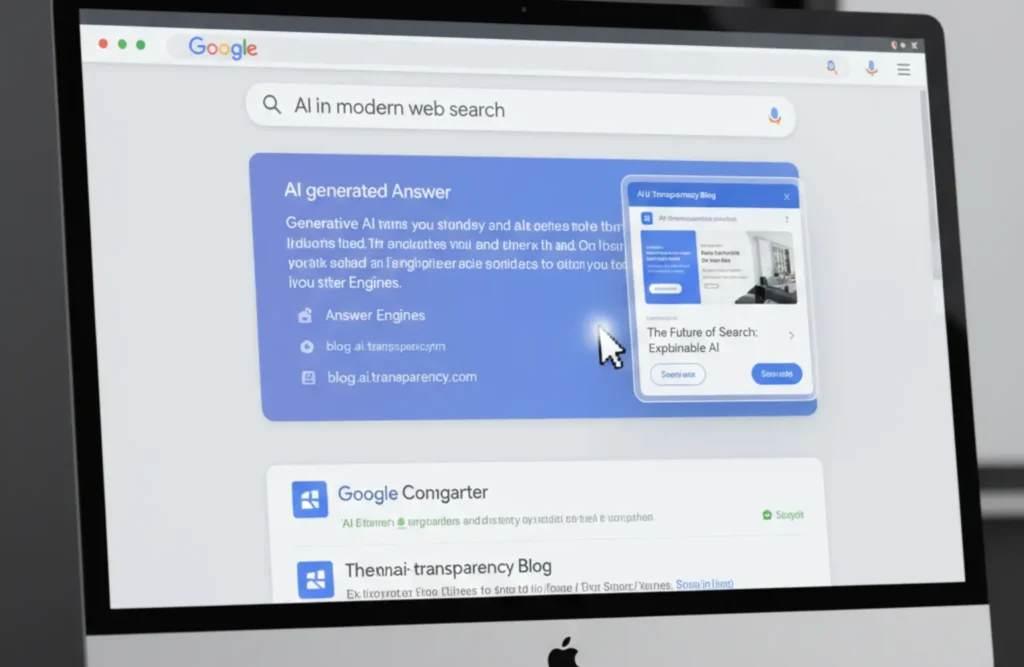
Google introduces hover link pop-ups in AI-generated search results on desktop, making it easier for users to preview and click through to original websites.
Google is rolling out a new feature designed to make links inside AI-generated search answers easier to find and use. On desktop, users will now see hover pop-ups when they move their cursor over links inside AI Overviews and AI Mode. The change is meant to help people quickly jump to original websites for more information.
The update was announced by Robby Stein, Vice President of Google Search. According to Google, early testing shows the new design encourages more interaction with links and helps users reach source content more easily.
How the New Hover Feature Works
With the new interface, links embedded in AI Overviews and AI Mode responses will display grouped previews when users hover over them on desktop. These pop-ups make it clearer where a link leads before clicking.
Google is also adjusting how links appear overall. Link icons will be larger and more descriptive across both desktop and mobile. The goal is to make it more obvious that AI answers are built using information from real websites. This feature is rolling out gradually and is currently limited to desktop devices. Google has not shared a specific timeline for full global availability.
Understanding AI Overviews and AI Mode
AI Overviews place a short, AI-generated summary at the top of the search results page. These summaries aim to answer questions quickly without requiring users to scroll through multiple links.
AI Mode offers a more conversational experience. Instead of traditional search results, users interact with a chatbot-style interface that responds to follow-up questions.
While both tools are designed to improve convenience, they have changed how users interact with search results. In many cases, people get the information they need without clicking through to a website.
Publishers Raise Traffic Concerns
The rise of AI-generated summaries has raised concerns among publishers and website owners. Many report declining traffic as users spend more time reading AI answers instead of visiting sources. Research supports these concerns. A study by the Pew Research Center found that users clicked on a link inside an AI summary in only 1 percent of visits to pages that included such summaries.
The same report showed another troubling trend. Users were more likely to end their browsing session entirely after viewing a page with an AI summary. This happened on 26 percent of pages with AI summaries, compared with 16 percent of pages that only showed traditional search results.
Organic Click Rates Continue to Fall
Other data points to similar patterns. An analysis by GrowthSRC Media, cited by Search Engine Journal, found that the top organic click-through rate dropped from 28 percent to 19 percent after AI Overviews expanded.
This decline suggests that even high-ranking websites are receiving fewer visits when AI summaries appear above them. For publishers that rely on search traffic for advertising and subscriptions, the impact can be significant. The hover pop-up update appears to be part of Google’s effort to reverse or soften this trend by making source links more visible and easier to access.
Regulatory Pressure in Europe
Google’s AI search features have also attracted regulatory scrutiny. Last year, the European Commission opened an investigation into whether Google’s AI-powered search tools breach competition rules. The investigation includes questions about whether Google is using content from digital publishers in its AI responses without providing fair compensation or visibility.
At the time, Teresa Ribera, one of the European Commission’s senior officials, highlighted the broader stakes involved. She said a free and democratic society depends on diverse media, open access to information, and a strong creative sector. These principles, she added, are central to European values.
Google’s Response to Criticism
Google has consistently said that AI Overviews are designed to help users explore topics more deeply and discover new sources. The company argues that AI answers often include multiple links, giving users more pathways to relevant content.
However, the data shows that many users still do not click through. The addition of hover pop-ups is the latest attempt to address this gap between intention and actual behavior. By making links more prominent and interactive, Google hopes users will be more inclined to visit original websites rather than stopping at the AI summary.
What This Means for Users
For everyday users, the update may improve transparency. Hover previews make it clearer where information comes from and allow faster access to full articles, guides, and research.
Users who want deeper context or more detailed explanations can now move directly from an AI answer to a trusted source with less friction. This may also help users compare information across multiple sites instead of relying on a single AI-generated summary.
What It Means for Publishers
For publishers, the change offers cautious optimism. While it does not guarantee higher traffic, it shows Google is responding to long-standing concerns from the publishing and SEO communities. Whether hover pop-ups will meaningfully increase click-through rates remains to be seen.
Much will depend on how prominently the links are displayed and how often users notice and use them. Still, the update signals that Google is aware of the growing tension between AI convenience and the sustainability of the open web.
A Small Step in a Larger Debate
The rollout of hover link pop-ups is a relatively small interface change, but it sits within a much larger debate about the future of search, AI, and digital publishing.
As AI continues to reshape how people find information, the balance between quick answers and fair visibility for content creators will remain a central issue. Google’s latest update suggests that the company is at least trying to adjust that balance, even as questions around traffic, competition, and regulation continue.
About The Author