China’s breakthrough in infrared chip manufacturing could make SWIR technology widely accessible.
A research team from Xidian University in China has unveiled a breakthrough that could fundamentally reshape the economics of infrared imaging technology. By developing a new way to manufacture high-end infrared chips using conventional semiconductor processes, the team claims it can reduce costs by as much as 99 percent. What was once a component priced in the hundreds or even thousands of dollars could soon cost as little as a few dozen dollars, with some estimates suggesting prices near $10 per chip.
This shift has the potential to move short-wave infrared sensing from a niche, high-cost technology into the mainstream, opening up applications across consumer electronics, automotive systems, and industrial automation.
Understanding Short-Wave Infrared Technology
Short-wave infrared, or SWIR, operates in a part of the electromagnetic spectrum that is invisible to the human eye but extremely useful for machine vision. Unlike traditional cameras that rely on visible light, SWIR sensors can capture images in complete darkness and through challenging environmental conditions such as fog, smoke, and haze.
This capability makes SWIR particularly valuable in scenarios where visibility is limited. In autonomous driving, for example, SWIR cameras can help vehicles detect obstacles and navigate safely in poor weather. In manufacturing, they can be used to inspect products through packaging or identify defects that are invisible under standard lighting conditions. In robotics, they enable machines to operate more reliably in low-light or visually complex environments.
Despite these advantages, SWIR technology has historically been confined to specialized use cases due to its high cost and manufacturing complexity.
Why SWIR Chips Have Been So Expensive
The primary reason for the high cost of SWIR chips lies in the materials traditionally used to produce them. Most high-performance SWIR detectors rely on indium gallium arsenide, a compound semiconductor that offers excellent sensitivity to infrared wavelengths. However, this material is difficult and expensive to produce, and it does not integrate easily with standard silicon-based manufacturing processes.
Because of these limitations, SWIR chips have been predominantly used in military and high-end applications such as satellite imaging, drone surveillance, and missile guidance systems. In these contexts, performance is prioritized over cost, making the expensive materials acceptable. For broader commercial adoption, however, the cost barrier has remained a major obstacle.
The Breakthrough: Silicon-Germanium Approach
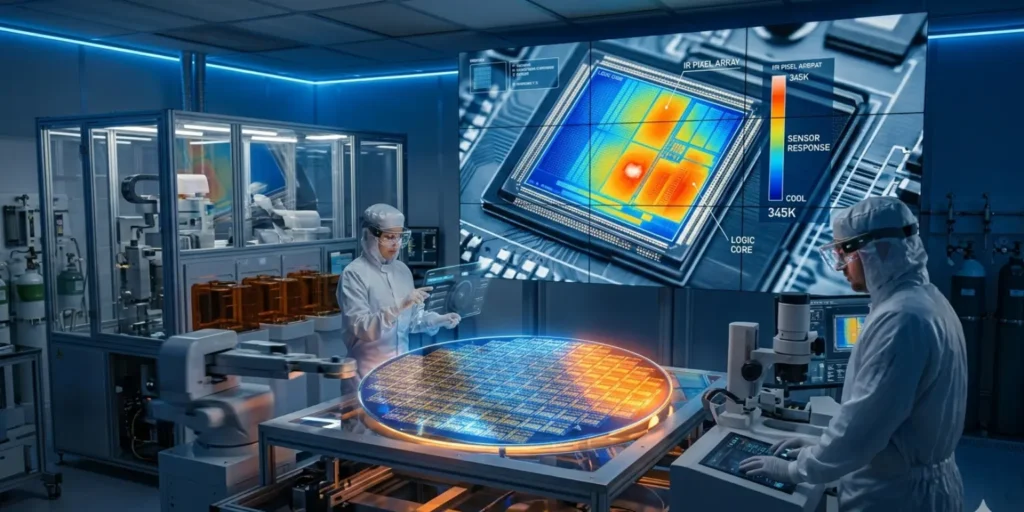
The team at Xidian University, led by Hu Huiyong, has taken a different approach by using silicon-germanium materials combined with complementary metal-oxide-semiconductor manufacturing techniques. These processes are already widely used in the production of conventional chips, including those found in smartphones and other consumer electronics.
By leveraging existing manufacturing infrastructure, the researchers have demonstrated that it is possible to produce SWIR detectors at a fraction of the traditional cost. According to team member Wang Liming, this approach allows SWIR chips to be manufactured using the same cost base as mainstream semiconductor products. If successfully scaled, this could eliminate one of the biggest barriers to widespread adoption.
Overcoming Technical Challenges
Achieving this breakthrough was not straightforward. One of the main challenges in combining silicon and germanium lies in the mismatch between their crystal lattice structures. The atomic spacing between the two materials differs by about 4.2 percent, which can lead to defects during fabrication. These defects can degrade performance and reduce the reliability of the chips.
To address this issue, the research team introduced buffer layers between the materials to absorb the structural mismatch. These layers act as a cushion, reducing the formation of defects. In addition, the team applied heat treatment and chemical sealing techniques to stabilize the chip surface and prevent electrical leakage.
These innovations allowed the researchers to achieve performance levels comparable to those of traditional SWIR chips, while maintaining the cost advantages of silicon-based manufacturing.
Performance Comparable to Industry Leaders
According to the university’s announcement, the new chips match or even exceed the performance of existing solutions in key areas such as detection efficiency and noise control. This places them in direct competition with technologies developed by leading industry players like Sony, TSMC, and Artilux.
This level of performance is critical because cost reductions alone would not be enough to drive adoption if the technology could not meet the standards required for demanding applications. By achieving both affordability and high performance, the new approach significantly strengthens its commercial viability.
Path to Mass Production
The research team is not stopping at the laboratory stage. Through collaboration with the Hangzhou Institute of Technology and their affiliated company Zhixin Semiconductor, they are building a complete in-house ecosystem for research, development, and manufacturing.
A dedicated silicon-germanium production line is currently under construction and is expected to begin operations by the end of the year. This indicates that the technology is moving rapidly toward commercialization, rather than remaining a purely academic achievement.
If mass production proceeds as planned, the market could see a significant increase in the availability of affordable SWIR sensors within a relatively short timeframe.
Implications for Consumer Technology
One of the most exciting aspects of this breakthrough is its potential impact on consumer devices. With costs reduced to levels comparable to standard smartphone components, SWIR sensors could be integrated into everyday gadgets.
In smartphones, this could enable advanced camera features such as improved low-light photography, enhanced depth sensing, and the ability to capture images through certain materials. These capabilities could redefine mobile photography and open up new use cases for augmented reality and security.
The integration of SWIR into consumer electronics would also drive further innovation, as developers explore new applications made possible by the technology.
Transforming Autonomous Vehicles and Robotics
Beyond consumer devices, the impact on autonomous systems could be even more significant. Self-driving cars rely heavily on sensors to interpret their surroundings, and current solutions can struggle in adverse weather conditions.
SWIR sensors offer a way to overcome these limitations by providing clear imaging in fog, rain, and smoke. With lower costs, automakers could incorporate these sensors into a wider range of vehicles, improving safety and reliability.
In robotics, particularly humanoid and industrial robots, the ability to “see” in challenging environments is crucial. Affordable SWIR technology could enhance navigation, object recognition, and operational efficiency across a variety of applications.
China Expanding Industrial and Scientific Applications
Industries such as manufacturing, agriculture, and healthcare could also benefit from the widespread adoption of SWIR technology. In manufacturing, SWIR imaging can be used for quality control, detecting defects that are invisible to standard cameras. In agriculture, it can help monitor crop health and optimize resource use.
Scientific research, which has long relied on expensive infrared equipment, could also see increased accessibility. Lower costs would allow more institutions and researchers to utilize advanced imaging techniques, potentially accelerating innovation in multiple fields.
From Military to Mainstream
Historically, SWIR technology has been closely associated with military and defense applications due to its high cost and advanced capabilities. The ability to see in complete darkness or through obscurants makes it valuable for surveillance, reconnaissance, and targeting systems.
However, the breakthrough by Xidian University signals a shift from exclusivity to accessibility. By bringing costs down dramatically, the technology is poised to transition from specialized use to widespread adoption across civilian industries.
This transition mirrors the evolution of many other technologies, which began in military or research settings before becoming integral to everyday life.
Conclusion: China Slashes Cost of Infrared Chips
The development of low-cost SWIR chips represents a significant milestone in the evolution of imaging technology. By combining innovative materials engineering with established manufacturing processes, researchers have opened the door to a new era of affordability and accessibility.
If the technology scales successfully, it could transform multiple industries, from consumer electronics to autonomous vehicles and beyond. What was once a niche capability reserved for high-budget applications may soon become a standard feature in everyday devices.
As mass production begins and real-world implementations emerge, the true impact of this breakthrough will become clearer. For now, it stands as a powerful example of how innovation in materials and manufacturing can unlock entirely new possibilities for technology and its applications.
About The Author