
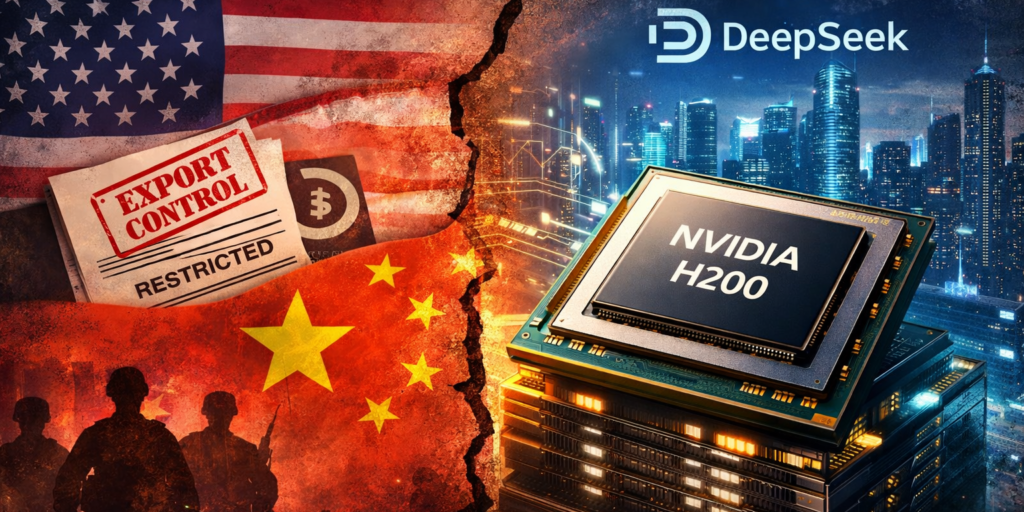
Illustration showing Nvidia’s H200 AI chip amid growing U.S.–China technology and export control tensions.
China has quietly allowed Nvidia’s advanced H200 AI chips to be sold to DeepSeek, a fast-rising domestic AI startup, though the approval comes with strict conditions. The move places DeepSeek in the same league as major Chinese tech giants such as ByteDance, Alibaba, and Tencent when it comes to access to high-end computing power.
The approval is not automatic or unrestricted. Multiple government bodies, including the National Development and Reform Commission, are finalizing the regulatory framework around these purchases. This reflects Beijing’s growing oversight of strategically important AI hardware and its intent to tightly manage how such technologies are acquired and deployed.
Just last week, Chinese technology firms were reportedly cleared to purchase more than 400,000 H200 chips, underscoring the scale of domestic demand for cutting-edge AI accelerators. Industry analysts estimate that Chinese companies have already placed orders exceeding two million units, each priced at roughly $27,000. This demand far outpaces Nvidia’s current supply, which is believed to be around 700,000 units, keeping prices elevated and reinforcing Nvidia’s dominance in the global AI infrastructure market.
U.S. Policy Shifts and Rising Geopolitical Pressure
The decision comes against the backdrop of evolving U.S. export controls. Washington has moved away from a near-total ban on advanced AI chip exports to China and adopted a more selective, license-based system.
As of January 15, exports of Nvidia’s H200 and AMD’s MI325X chips are permitted only under strict licensing rules. These include third-party verification, caps that limit Chinese purchases to less than half of U.S. export volumes, and explicit bans on military use. On top of that, a 25 percent federal surcharge applies to each chip sold to Chinese buyers, adding a geopolitical premium to already expensive hardware.
Despite these safeguards, concerns remain in Washington. A senior U.S. lawmaker has accused Nvidia of indirectly enabling DeepSeek to develop AI models that could later serve military purposes. Such claims increase the likelihood of further scrutiny if large-scale shipments move forward. As one export control specialist put it, every H200 sent to China under current conditions represents a political decision, not just a commercial transaction.
What This Means for DeepSeek
DeepSeek has quickly emerged as one of China’s most closely watched AI startups, reaching an estimated valuation of $3.4 billion in early 2025. Access to Nvidia’s H200 chips could significantly accelerate its progress, allowing it to operate at performance levels closer to leading Western AI labs at a time when companies worldwide are reassessing AI-related risks.
Still, the path ahead is far from smooth. Conditional approvals from Beijing, combined with ongoing U.S. licensing constraints, make large-scale expansion both uncertain and politically sensitive.
Over the coming year, observers will be watching three key developments: how much of China’s reported two-million-plus H200 demand is actually fulfilled, whether DeepSeek’s latest model iterations translate into meaningful revenue growth, and whether Washington tightens export rules further if allegations of military use gain traction.
About The Author