
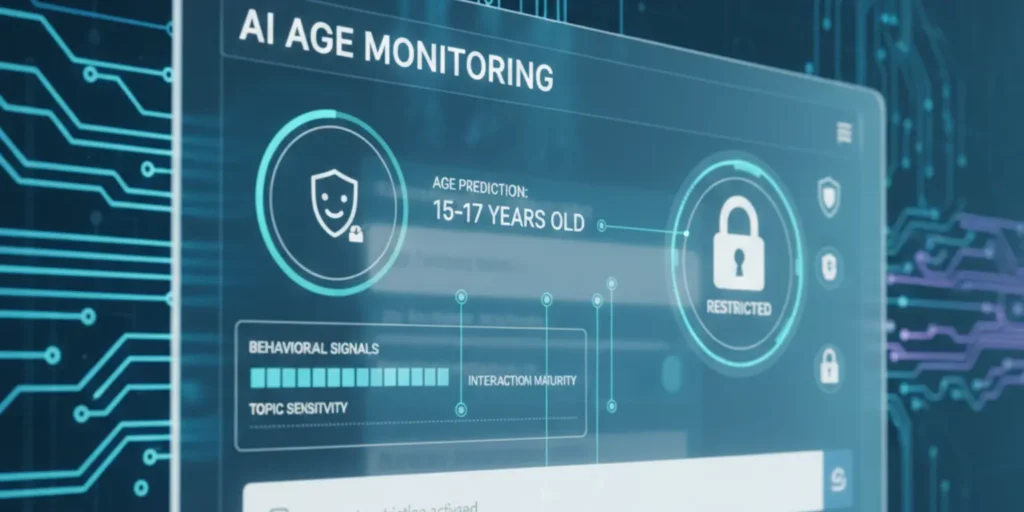
OpenAI’s new age prediction model for ChatGPT aims to restrict sensitive content for users suspected to be under 18, sparking debate over privacy and accuracy.
OpenAI has rolled out a new age prediction system for ChatGPT, and it is already drawing strong reactions. Launched globally on January 20, 2026, the tool aims to limit children’s access to what the company calls sensitive or mature content.
While the goal is child safety, critics say the system raises serious concerns about accuracy, privacy, and unintended harm. The debate highlights a growing challenge in artificial intelligence: how to protect minors online without unfairly restricting or mislabeling users.
How the Age Prediction System Works
OpenAI says the new model does not rely on a single data point. Instead, it looks at a mix of behavioral and account-level signals to estimate whether a user may be under 18. These signals include how long an account has existed, common times of day when the account is active, overall usage patterns, and the age a user has stated in their profile. When the system believes a user is a minor, ChatGPT automatically applies stricter safeguards.
These protections are designed to reduce exposure to content related to self-harm, graphic violence, sexual roleplay, and other topics considered inappropriate for children. OpenAI says this approach allows the platform to apply safety measures without requiring users to upload identity documents or go through constant verification checks.
Automatic Restrictions for Suspected Minors
Once an account is flagged as belonging to someone under 18, certain types of content are blocked or heavily filtered. This includes graphic descriptions, explicit roleplay, and detailed discussions of self-harm. The company argues that these limits are necessary as ChatGPT becomes more widely used by students and younger users around the world. OpenAI has stated that the system is meant to reduce harm, not to punish or surveil users. Still, many users worry about how often the system might get it wrong.
A History of AI Safety Gaps
Concerns about the new model are amplified by the broader state of AI safety testing. According to a recent global survey, only 6 percent of education organizations currently use AI red-teaming. Red-teaming is a process where systems are tested against misuse, edge cases, and malicious behavior before full deployment.
The Kiteworks Data Security and Compliance Risk Forecast for 2026 calls this gap one of the most serious risks in the AI space. The report warns that tools affecting students and minors are often released without enough adversarial testing, increasing the chance of errors or abuse. Critics argue that OpenAI’s age prediction system is being deployed into this same risky environment.
Lessons From Past Failures
Similar systems have already shown how things can go wrong. In early 2026, Roblox introduced selfie and ID-based age checks. The results were messy. Adults in their twenties were incorrectly labeled as teenagers, while some children were mistakenly classified as adults due to parent account settings.
These errors happened just weeks after rollout and led to frustration among users and parents. The situation raised doubts about whether automated age detection can work reliably at scale. For many observers, this history makes OpenAI’s move feel rushed.
Rising Abuse Adds Pressure
The push for stronger age controls comes at a time when online child safety threats are growing fast. Reports to the National Center for Missing and Exploited Children show a sharp rise in AI-generated child abuse images.
In 2024 alone, reports jumped to more than 67,000, up from about 4,700 the year before. That represents an increase of over 1,300 percent in just one year. This surge has put pressure on tech companies to act quickly, even if the solutions are not perfect.
Privacy and Accuracy Concerns
One of the biggest worries surrounding OpenAI’s model is how it interprets behavior. Activity at certain hours, changes in usage patterns, or a newer account could wrongly suggest a user is under 18.
Adults who are misclassified may suddenly face content restrictions without clear explanations or easy ways to appeal. On the other hand, determined minors may still find ways to bypass the system. Privacy advocates also question how much behavioral monitoring is appropriate, even if no official ID is required.
What Comes Next
Looking ahead, experts expect constant attempts to bypass the system. If false positives remain common, OpenAI could also face legal challenges from users who feel unfairly restricted.
Some governments are already testing hybrid approaches that combine AI estimation with optional identity checks to reach higher accuracy. Australia, for example, is trialing systems that aim for reliability rates close to 99 percent. Whether OpenAI follows a similar path remains to be seen.
The Real Test for AI Age Detection
As the age prediction model rolls out worldwide, success will not be measured only by how many minors are blocked. The real question is whether AI can estimate age accurately without damaging trust, limiting legitimate users, or creating new risks.
For now, the system reflects a difficult balance between child protection and user rights. How OpenAI handles errors, transparency, and appeals may ultimately decide whether this approach becomes a standard or a cautionary tale.
About The Author