
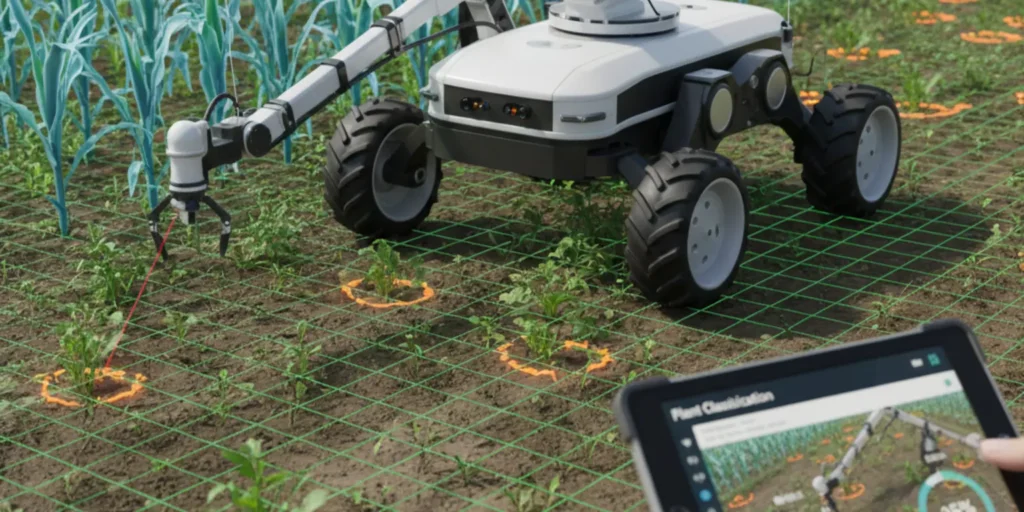
Carbon Robotics unveils a new AI model that can recognize crops and weeds in real time without retraining.
Deciding which plants should stay in a field and which ones need to be removed has always relied on a farmer’s experience and judgment. Now, that decision is increasingly being supported by advanced technology. Carbon Robotics, a Seattle-based company known for its autonomous weed-killing machines, has unveiled a new artificial intelligence model that can identify plants instantly and adapt to new conditions without retraining.
The company announced its new Large Plant Model, or LPM, which allows its machines to recognize plant species in real time. This breakthrough removes a major limitation that previously slowed down automated weed control and gives farmers more direct control over what happens in their fields.
How Carbon Robotics Uses Technology to Kill Weeds
Carbon Robotics is best known for building the LaserWeeder, a robotic system that uses lasers to destroy weeds without harming crops. The robots move through fields, scan plants, identify weeds, and eliminate them with precision. Until recently, the system relied on plant recognition models that required constant updates. If a new weed appeared, or if a familiar weed looked different due to soil conditions or growth stages, the robots often needed retraining to recognize it correctly.
This process required collecting new data, labeling images, and updating the model. According to the company, this could take up to a full day each time, slowing down operations during critical farming periods.
What the Large Plant Model Changes
The Large Plant Model changes how plant recognition works inside Carbon Robotics’ machines. Instead of needing retraining for each new weed, the model can now understand and classify plants immediately.
The model has been trained on more than 150 million images and data points gathered from Carbon Robotics machines operating on over 100 farms across 15 countries. This massive dataset allows the system to recognize patterns and structures in plants at a deeper level.
As a result, the model can identify a plant it has never seen before and determine whether it is a crop or a weed. This ability is now the foundation of Carbon artificial intelligence, the software system that powers the company’s robotic fleet.
Farmers Can Now Make Decisions in Real Time
One of the most important benefits of the new model is how it changes the farmer’s role. Farmers no longer need to wait for engineers or software updates when something new appears in the field. Instead, they can simply point out a plant and tell the machine whether it should be removed or protected.
This instruction happens directly through the robot’s interface, using photos collected by the machine itself. According to Carbon Robotics founder and CEO Paul Mikesell, this level of flexibility has never been available before. Farmers can now respond instantly to changes in their fields without delays or technical barriers.
Why Retraining Is No Longer Needed
Before the Large Plant Model, Carbon Robotics had to label new data whenever plant appearances changed. Even the same weed could require retraining if it grew in different soil or lighting conditions. The new model works differently. It understands plants based on their structure, shape, and relationships rather than relying only on exact visual matches.
This allows it to generalize from existing knowledge and apply it to new situations. Because of this deeper understanding, the model does not need additional labeling or retraining to recognize new weeds. It can adapt on the spot, which saves time and improves accuracy in real-world conditions.
Years of Experience Behind the Model
Paul Mikesell founded Carbon Robotics in 2018 and brings years of experience in building advanced neural networks. Before starting the company, he worked at Uber and was involved in technology development for Meta’s Oculus virtual reality headsets.
Development of the Large Plant Model began shortly after Carbon Robotics shipped its first machines in 2022. As the robots operated on more farms, they continuously collected images and data that helped train and refine the model. Over time, this growing dataset became large enough to support a system that could recognize plants with minimal human intervention.
Rolling Out the Update to Existing Machines
The new model will be deployed to current Carbon Robotics customers through a software update. Farmers already using the LaserWeeder will gain access without needing new hardware.
Once updated, the system allows users to select which plants should be removed and which should be preserved. The machine learns directly from those choices and applies them immediately across the field. This approach gives farmers more control while keeping the technology simple to use.
Strong Backing and Continued Development
Carbon Robotics has raised more than $185 million in venture capital funding. Its investors include Nvidia Ventures, Bond, and Anthos Capital, among others. This financial support has helped the company scale its operations and invest heavily in research and development.
The company plans to continue improving the Large Plant Model as more data is collected. Each robot in the field contributes new information, making the system smarter over time. Mikesell believes the model has reached a point where it can analyze almost any plant image and determine its species, structure, and relationships, even if it has never encountered that exact plant before.
What This Means for the Future of Farming
The introduction of the Large Plant Model represents a major step forward for precision agriculture. By reducing reliance on chemical herbicides and manual labor, Carbon Robotics’ technology offers a more sustainable and efficient way to manage weeds.
For farmers, the ability to respond instantly to changing field conditions can lead to better yields and lower costs. For the agriculture industry as a whole, tools like this point toward a future where automation and human expertise work side by side. As Carbon Robotics continues to refine its model, the line between farmer intuition and machine intelligence grows thinner, bringing modern farming closer to real-time, data-driven decision making.
About The Author