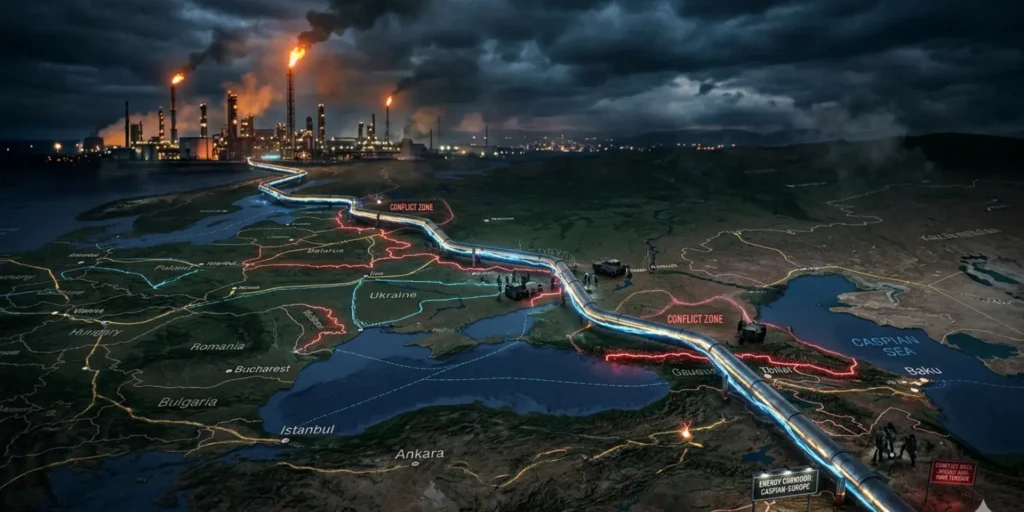
“The BTC pipeline emerges as a critical energy route as Gulf tensions reshape global oil supply chains.”
Rising tensions in the Gulf region are beginning to reshape global oil flows, and one pipeline in particular is now playing a critical role in keeping energy supplies steady. The Baku-Tbilisi-Ceyhan pipeline, commonly known as BTC, has emerged as a key route for crude oil moving into Europe at a time when traditional supply chains are under pressure.
As conflict disrupts the Middle East, European refiners are turning toward alternative sources. This shift is tightening crude markets in the Mediterranean and pushing prices higher for certain grades of oil that are seen as more reliable and accessible. The result is a clear change in how energy is being sourced and traded across the region.
Mediterranean Crude Markets Tighten
Oil markets in the Mediterranean have become noticeably tighter in recent weeks. Premiums for key crude grades have risen sharply above the Brent Crude benchmark, signaling strong demand and limited supply.
This tightening is closely linked to ongoing instability in the Gulf. As uncertainty grows, buyers are becoming more cautious about relying on Middle Eastern oil. Instead, they are looking for supplies that are geographically closer and less exposed to geopolitical risks.
European refiners, in particular, are driving this shift. Their need for a steady and predictable supply has pushed them to seek alternatives, even if those options come at a higher cost. This has led to a steady rise in both crude and refined product prices across the region.
A Shift Away from the Middle East
The current situation highlights a broader structural change in global energy markets. For decades, Europe has relied heavily on oil from the Middle East. However, recent geopolitical tensions have made that dependence riskier.
The conflict in the Gulf has disrupted supply chains and created uncertainty around future deliveries. Even when oil is available, concerns about transport routes, security, and insurance costs are making it less attractive to buyers.
As a result, European refiners are increasingly diversifying their sources. This includes turning to the Caspian region, where oil can be transported through pipelines that avoid some of the risks associated with maritime routes in conflict zones.
CPC Blend Sees a Sharp Turnaround
One of the most notable developments has been the change in pricing for Kazakhstan’s CPC Blend crude. Previously, this grade was often sold at a discount to Brent, sometimes as much as five dollars per barrel.
In recent weeks, however, the situation has reversed. Cargoes for March and April are now trading at premiums of $1–$2 per barrel over Brent. This shift reflects tighter supply and increased demand.
Several factors have contributed to this change. Adverse weather conditions, operational issues at major oil fields like Tengiz, and security concerns in the Black Sea have all limited availability. At the same time, demand has increased as buyers look for alternatives to Middle Eastern oil.
Rising Risks in the Black Sea
The Black Sea region has become another area of concern for oil markets. Security risks are adding uncertainty to supply chains and increasing costs for transportation and insurance.
A recent incident involving a tanker near the Caspian Pipeline Consortium terminal highlighted these risks. Although the damage was minor and did not significantly disrupt flows, it raised concerns about the safety of energy transport routes.
These risks are having a mixed impact on the market. On one hand, they support higher prices by limiting supply. On the other hand, rising costs for shipping and insurance are preventing prices from rising even further.
Azeri BTC Emerges as a Preferred Option
While CPC Blend has faced challenges, Azerbaijan’s Azeri BTC crude has become one of the most sought-after grades in the market. Its relatively stable supply and reliable transport routes have made it especially attractive to European buyers.
Premiums for Azeri BTC have risen significantly, with April cargoes trading at five to six dollars per barrel above Brent. In some cases, deals have been reported at even higher levels, reaching up to eight or nine dollars per barrel.
This strong demand reflects the growing importance of the BTC pipeline as a secure and efficient route for oil exports. Unlike some other supply chains, BTC has managed to maintain steady flows despite the broader instability in the region.
The Strategic Role of the BTC Pipeline
The Baku-Tbilisi-Ceyhan pipeline plays a central role in connecting Caspian oil reserves to global markets. Stretching from Azerbaijan through Georgia to Turkey’s Mediterranean coast, it provides a direct route for oil to reach Europe without passing through more volatile.
Since it began operations in 2006, the pipeline has transported hundreds of millions of tonnes of crude oil. Its importance has grown even further in the current environment, where reliability and security are top priorities for buyers.
The pipeline’s ability to deliver a consistent supply has made it a cornerstone of Europe’s evolving energy strategy. As traditional routes face disruption, BTC is increasingly seen as a lifeline.
Cooperation Strengthens Regional Supply
Recent cooperation between Azerbaijan and Kazakhstan has further strengthened the role of the Caspian region in global energy markets. Through partnerships involving the State Oil Company of the Azerbaijan Republic and Kazakhstan’s KazMunayGaz, more oil is being transported via the Caspian corridor.
Kazakh crude is shipped across the Caspian Sea and then fed into the BTC pipeline for export. This route has become an important alternative, especially as other supply chains face disruptions.
Transit volumes have been steadily increasing, reflecting growing demand and improved coordination between the two countries. This collaboration highlights how regional partnerships can help stabilize global energy supplies during times of uncertainty.
Infrastructure and Security Challenges
Despite its advantages, the BTC pipeline is not without risks. Reports of potential drone threats and other security concerns have raised questions about the safety of the infrastructure.
While operations have continued without major disruptions, these threats underline the fragile nature of energy systems in conflict-affected regions. Any significant damage to the pipeline could have serious consequences for global oil markets.
At the same time, efforts to restart other export routes, such as shipments through Turkey’s Ceyhan port, could help increase supply. These developments may ease some of the pressure on prices, but they also depend on continued stability and coordination between governments.
Changing Economics of Oil Supply
The rise in premiums for Mediterranean crude is a clear sign of changing market dynamics. Buyers are willing to pay more for oil that is reliable, accessible, and less exposed to geopolitical risks.
This shift is not just temporary. It reflects a deeper change in how energy markets operate. As uncertainty becomes a constant factor, flexibility and diversification are becoming more important than ever.
For European refiners, this means building a more resilient supply chain that can adapt to changing conditions. For producers in the Caspian region, it presents an opportunity to play a larger role in global markets.
The Caspian Region Moves to the Center
The current situation has brought the Caspian oil basin into the spotlight. Once considered a secondary source of supply, it is now becoming a central part of the global energy system.
This transformation would have been difficult to imagine just a few years ago. However, ongoing instability in the Middle East and other regions has accelerated the shift.
As demand continues to grow, the Caspian region is likely to remain a key player. Its resources, combined with strategic infrastructure like the BTC pipeline, position it as a reliable alternative in an uncertain world.
Outlook: Continued Volatility Ahead
Despite the growing importance of alternative supply routes, the outlook for oil markets remains uncertain. Tensions in both the Gulf and the Black Sea are unlikely to disappear in the near future.
This means that volatility will continue to shape market conditions. Prices may fluctuate, supply chains may face disruptions, and buyers will need to remain flexible.
However, one trend is clear. The shift toward diversified and regionally accessible energy sources is here to stay. The BTC pipeline and the broader Caspian region will play a crucial role in this new landscape.
Conclusion
The rise of the BTC pipeline as a key energy route highlights how quickly global markets can adapt to changing geopolitical realities. As Gulf tensions disrupt traditional supply chains, Europe is turning to alternative sources that offer greater reliability and security.
This shift is reshaping the oil market, driving up premiums for certain crude grades and elevating the importance of regions like the Caspian basin. While challenges remain, the growing role of the BTC pipeline shows how infrastructure and cooperation can help maintain stability in an increasingly uncertain world.
In the months ahead, all eyes will remain on energy flows, geopolitical developments, and the evolving balance between risk and reliability in global oil markets.
About The Author