
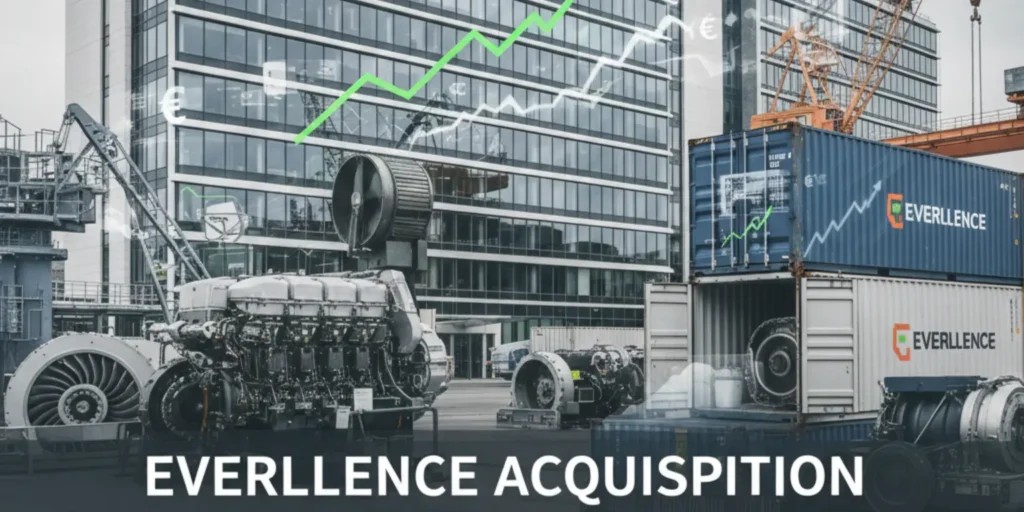
Major private equity firms, including Blackstone, EQT, and CVC, submit bids for Volkswagen’s Everllence division as the German automaker looks to divest non-core industrial assets.
Several major private equity firms have submitted offers for Volkswagen’s Everllence division, marking a key step in the German carmaker’s effort to reshape its business. According to reports, bidders include Blackstone, EQT, and CVC, all of which are among the world’s largest buyout groups.
The interest highlights strong investor appetite for industrial assets, even as Europe’s automotive sector faces slowing demand and rising competition from China.
Everllence Valued Up to €6 Billion
The deadline for initial bids for Everllence passed last week. People familiar with the process say potential buyers are valuing the business between €5 billion and €6 billion.
Everllence was previously known as MAN Energy Solutions and focuses on producing shipping engines, industrial power systems, and heat pumps. Although it operates outside Volkswagen’s core car business, it plays an important role in heavy industry and energy-related applications.
Volkswagen is planning to sell a majority stake in the unit while keeping a significant minority holding. This approach would allow the group to raise capital while still benefiting from Everllence’s long-term performance.
Other Interested Buyers
In addition to Blackstone, EQT, and CVC, other buyout firms have shown interest in Everllence during earlier stages of the process. These include CD and R and industrial carve-out specialist KPS. Sources also said that some rival industrial companies explored possible bids before the deadline.
Not all early interest resulted in formal offers, but the range of potential buyers underlines the appeal of the asset. Everllence operates in sectors that are expected to see steady demand over the long term, particularly shipping efficiency and energy transition technologies.
Why Volkswagen Is Selling
Selling Everllence would support Volkswagen’s broader strategy to streamline its operations and focus on its core automotive brands. The company is under pressure as global car demand weakens and Chinese manufacturers gain market share, especially in electric vehicles.
By divesting non-core assets, Volkswagen aims to free up capital, improve efficiency, and strengthen its balance sheet. The group has been reviewing several parts of its business as it looks to adapt to changing market conditions.
Despite these challenges, Volkswagen reported stronger-than-expected results from its automotive division. In 2025, the company generated €6 billion in net cash flow, well above its earlier forecasts. This improvement reflects ongoing cost-cutting efforts and better operational discipline.
Parallel Sale at Continental
The potential sale of Everllence comes at the same time as another major industrial divestment in Germany. Continental is in the process of auctioning ContiTech, its belts and hoses division.
Continental is aiming to refocus its business entirely on tyres and sees ContiTech as a non-core asset. The company has continued with the sale despite issuing a profit warning for the unit last month and despite the overlap with Volkswagen’s Everllence auction.
One German investment banker described the situation as unusual, noting that it is rare to see two similar industrial assets from the same country being sold at the same time.
ContiTech Performance and Outlook
ContiTech’s operating profit margin stood at 4.9 percent in 2025 after a weak final quarter. This figure was below Continental’s target range, raising questions among some investors. However, Continental believes the unit still offers strong upside potential.
According to a person familiar with the company’s thinking, management has been pitching ContiTech as a business that could benefit significantly from fresh investment and restructuring under new ownership. The company remains confident that a deal can be reached this year despite market uncertainty.
Broader Industry Trends
The planned divestments by Volkswagen and Continental reflect a wider trend across Europe’s industrial sector. Many large groups are selling off non-core assets to simplify their structures and focus on their most profitable businesses.
Rising energy costs, increased imports from China, and higher expenses linked to environmental regulation have all added pressure on manufacturers. At the same time, the transition to electric vehicles has been slower than many companies initially expected.
These conditions have created opportunities for private equity firms, which often see value in buying complex divisions and improving performance through targeted investment and management changes.
Private Equity Interest Remains Strong
Private equity groups have been particularly active in European carve-outs. According to data from PitchBook, nearly €60 billion worth of European private equity carve-out deals were completed by early November last year.
These transactions accounted for around 13.5 percent of total private equity deal value in the region. Investors see carve-outs as a way to acquire established businesses that may perform better outside large corporate groups.
No Official Comment Yet
Representatives for Volkswagen, Blackstone, EQT, CVC, CD, and R, and KPS declined to comment on the bidding process.
As the sale process moves forward, attention will turn to which bidder emerges as the preferred buyer and how Volkswagen plans to use the proceeds. The outcome could also influence other European manufacturers considering similar asset sales.
About The Author