
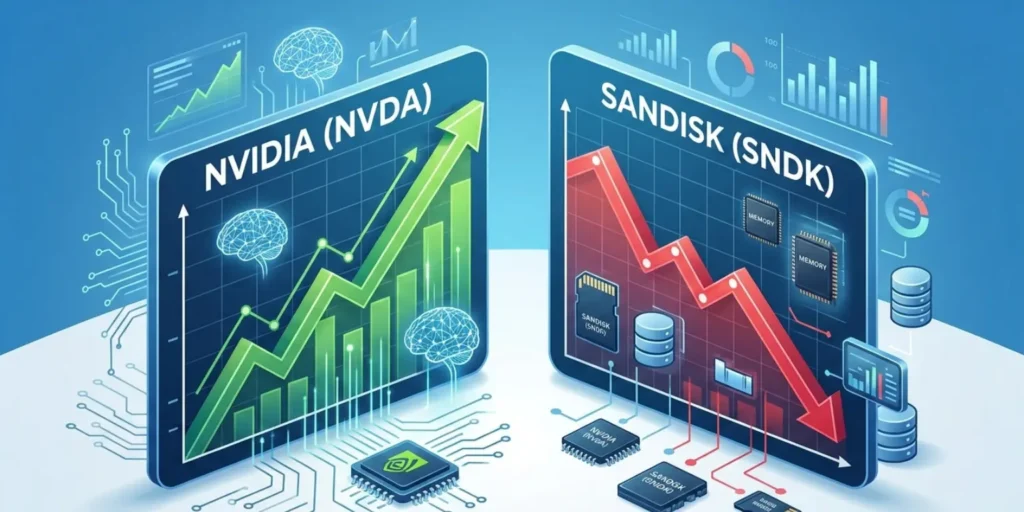
Billionaire hedge fund managers are increasing Nvidia holdings while reducing SanDisk stakes, betting on AI growth over memory market cycles.
Two well-known billionaire hedge fund managers made a clear move in late 2025. They bought more shares of Nvidia and sold a large portion of their holdings in SanDisk. This decision shows where they believe the strongest growth will come from in the coming years.
The focus is now firmly on artificial intelligence. Chips that power AI systems are attracting serious money, while traditional memory companies face more uncertainty.
Big Portfolio Changes in Late 2025
Cliff Asness, who runs AQR Capital Management, increased his investment in Nvidia by 18 percent during the fourth quarter of 2025. He added about 3.9 million shares. NVIDIA is now his firm’s largest holding, worth billions of dollars. At the same time, he reduced his position in SanDisk by 22 percent. He sold more than 300,000 shares. SanDisk is no longer among his top 50 holdings.
Steven Schonfeld of Schonfeld Strategic Advisors made a similar move. He tripled his exposure to Nvidia by purchasing around 2 million additional shares. NVIDIA is now the third largest position in his portfolio. Schonfeld also cut his SanDisk stake by 27 percent. Both managers clearly chose to increase their bet on AI chips and reduce exposure to memory storage.
Why These Moves Matter
These two hedge fund leaders have delivered strong returns in recent years. Over the past three years, their funds have outperformed the broader market, including the S&P 500.
Because of their track record, many investors pay close attention to what they buy and sell. Large shifts like this often signal where experienced professionals see better long-term potential.
In this case, the message seems clear. They believe companies tied directly to artificial intelligence infrastructure have stronger prospects than memory manufacturers.
NVIDIA’s Strong Position in AI
NVIDIA has become a central player in the AI industry. Its graphics processing units, or GPUs, are widely used in data centers that train and run artificial intelligence systems. Industry estimates from firms such as Bernstein and TD Cowen suggest that Nvidia captures more than half of AI infrastructure spending. Storage companies account for only a small percentage of total costs.
This difference is important. When companies build AI systems, they spend heavily on computing power. Memory and storage are necessary, but they represent a smaller share of the overall budget. That spending pattern gives Nvidia a stronger growth path as AI demand continues to rise.
SanDisk’s Market Position
SanDisk operates in the NAND flash memory market. It ranks fifth globally behind large competitors such as Samsung Electronics and Micron Technology. Recently, SanDisk benefited from supply shortages in the memory market. Those shortages helped push prices higher. As a result, its stock experienced a sharp increase over the past year.
As of March 4, 2026, SanDisk shares were trading above 600 dollars after gaining more than 1,200 percent over the previous year. That kind of rapid rise often attracts attention, but it can also raise concerns about sustainability. Memory markets tend to move in cycles. When supply increases again, prices can fall quickly.
Revenue and Profit Differences
NVIDIA’s most recent quarterly results highlight why investors are confident. In the fourth quarter, the company generated more than 68 billion dollars in revenue. That was an increase of over 70 percent compared to the same period a year earlier. Revenue also exceeded Wall Street expectations by nearly 2 billion dollars. That performance reflects strong demand for its AI chips and related software.
SanDisk’s profit margins are respectable, but they are similar to those of other memory companies. Margins in this space can shrink quickly when supply catches up with demand. NVIDIA benefits from more than just hardware sales. Its software ecosystem, including tools and platforms built around its chips, helps lock in customers. This creates a stronger competitive position.
Comparing Valuations
Valuation is another reason investors may prefer Nvidia at the moment. The company is trading at around 38 times adjusted earnings. While that may sound high, its earnings grew by more than 80 percent in the latest quarter. In fact, Nvidia’s current price-to-earnings ratio is below its two-year average of 53. That suggests the stock is not as expensive as it has been in the recent past.
SanDisk’s valuation looks less stable when you consider how quickly its stock price rose. A surge driven by supply shortages may not last if market conditions change. When growth is tied to a long-term structural trend like AI, investors often feel more comfortable paying a premium. When growth depends on short-term supply issues, the risk level is higher.
Risk and Outlook for 2026
No stock is without risk. NVIDIA operates in a competitive and fast-changing industry. Demand for AI hardware could slow if companies reduce spending. However, the broader trend toward artificial intelligence appears strong. Businesses across sectors continue to invest in AI tools and infrastructure.
SanDisk faces a different set of challenges. Memory markets are known for sharp booms and busts. If production increases later in 2026, prices could fall, putting pressure on profits and stock performance. This contrast likely influenced the hedge fund managers’ decisions. They chose the company tied to long-term AI growth rather than one exposed to cyclical supply swings.
Conclusion: Billionaire Investors Shift Toward Nvidia From SanDisk
The recent moves by Cliff Asness and Steven Schonfeld highlight a clear preference. They are increasing their exposure to Nvidia while stepping back from SanDisk. Their decision reflects confidence in artificial intelligence as a powerful and lasting trend. NVIDIA stands at the center of that shift, supplying the chips that power data centers and advanced computing systems.
SanDisk enjoyed a strong run due to supply shortages, but its future depends more on market cycles. For investors seeking steady growth linked to AI expansion, Nvidia currently appears to offer the stronger case. As 2026 unfolds, the performance of both stocks will show whether these billionaire investors made the right call. For now, the smart money seems firmly positioned behind AI leadership rather than memory market momentum.
About The Author