
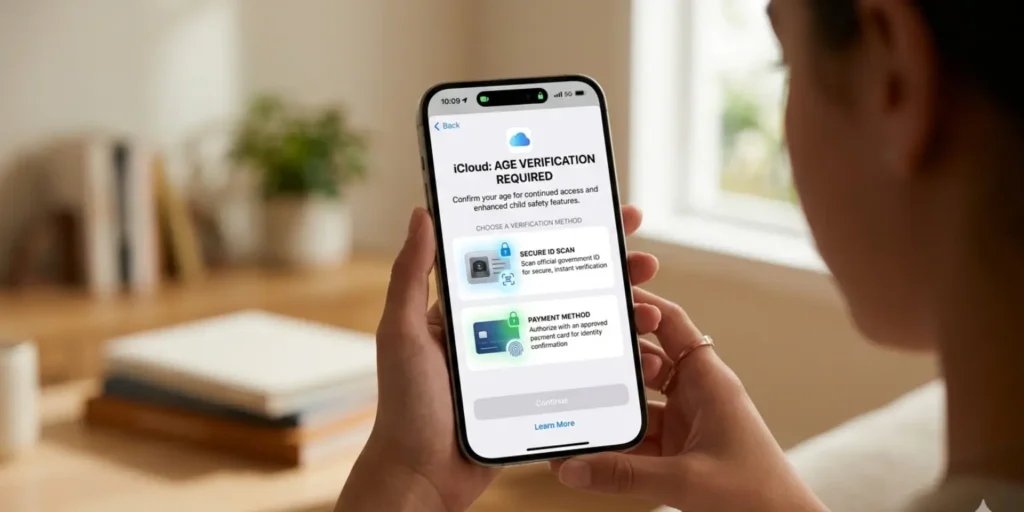
iPhone displaying iCloud age verification prompt with ID scan and payment verification options, emphasizing secure and child-safe features.
Apple has long been recognized for its focus on privacy, security, and user safety across its devices and services. With the release of iOS 16.4, the company has introduced an important addition to its user protection framework: age verification for iCloud accounts in the United Kingdom. This new measure is designed to ensure that certain services, features, and account actions are restricted to users who are 18 years or older, marking a significant step in digital age assurance and online safety.
While Apple’s iOS updates often introduce features aimed at enhancing user experience—like its AI-driven playlist generator—the age verification initiative is about responsible digital access. In a time when children and teenagers increasingly interact with devices and online services, implementing safeguards around content and services is both timely and necessary.
How the Age Verification System Works
Apple’s age verification process is integrated directly into iCloud account management. Users in the UK who attempt to access certain services or perform specific actions on their account will now be prompted to verify their age. There are several ways to confirm that a user is 18 or older:
- Linking a Payment Method: Users can verify their age by linking a credit or debit card to their iCloud account. Apple can use the payment information to validate the user’s date of birth.
- Government ID Verification: Users may scan an official form of identification, such as a passport or driver’s license, to prove their age.
- Existing Payment Records: For individuals who have maintained an Apple account for some time, Apple can check if there is already a payment method on file that verifies the user’s age.
These methods aim to make the process user-friendly while maintaining high security standards, ensuring that age verification is reliable without creating unnecessary barriers for legitimate users.
Automatic Safety Measures for Minors
To reinforce protection for younger users, Apple has automatically activated several safety features for anyone under 18 or for those who have not verified their age. These features include:
- Web Content Filter: This system is built into Safari and other third-party browsers on iOS, iPadOS, and macOS. It restricts access to websites that Apple classifies as inappropriate for minors.
- Communication Safety Alerts: Apple monitors image and video content sent or received through iMessage. If the system detects nudity in a message, it warns the user, and depending on the age of the recipient, it can provide guidance to prevent the sharing of sensitive material.
Together, these protections aim to reduce exposure to potentially harmful online content while still allowing children and teenagers to enjoy digital services safely.
A Move Beyond Legal Requirements
Interestingly, Apple’s decision to implement age verification in the UK goes beyond what is currently mandated under the region’s Online Safety Act. The Online Safety Act sets standards for protecting children online, including requirements for platforms to implement content moderation and age-appropriate safeguards. However, the act does not specifically require age verification for iOS or App Store accounts.
By voluntarily introducing these measures, Apple is positioning itself as a leader in proactive child safety. The move signals the company’s commitment to user protection even in the absence of legal compulsion, which could influence other technology companies to adopt similar measures in the UK and globally.
Praise from Regulators
The UK’s communications regulator, Ofcom, has publicly commended Apple for this initiative. Ofcom highlighted the company’s efforts to make the UK one of the first countries to receive enhanced child safety protections on consumer devices. The regulator emphasized that the rules are designed to be flexible, encouraging innovation while keeping users safe.
Ofcom stated:
“Apple’s decision that the UK will be one of the first countries of the world to receive new child safety protections on devices is a real win for children and families. Our rules are flexible and designed to encourage innovation, particularly in age assurance. We’ve worked closely with Apple and other services to ensure they can be applied in a variety of contexts to ensure users are protected. This will build on the strong foundations of the Online Safety Act, from widespread age checks that keep young people away from harmful content, to blocking high-risk sites and stepping up action against child sexual abuse material.”
This endorsement reflects the alignment of corporate initiatives with public policy goals, signaling a potential new standard for tech companies regarding proactive age verification.
Implications for Users and Families
For end users, especially parents and guardians, Apple’s new measures provide several key benefits:
- Enhanced Peace of Mind: By verifying ages and implementing protective features, parents can feel more confident that their children are shielded from inappropriate content.
- Clearer Boundaries: Automatic activation of content filters and communication safety tools helps children navigate the digital world safely while still allowing them access to age-appropriate content.
- User Accountability: By linking accounts to verified ages, Apple reduces the likelihood of underage users bypassing restrictions or accessing mature content in apps, services, and web browsers.
For teens themselves, the system ensures a safer online environment without overly restricting access to beneficial tools, apps, and services.
Broader Context: Digital Safety and Age Assurance
Apple’s introduction of age verification aligns with a broader industry trend toward safer digital experiences for minors. With children spending more time online, exposure to potentially harmful content—ranging from inappropriate videos to social media risks—is an increasing concern for regulators, educators, and families.
Several key trends contextualize Apple’s move:
- Rising Regulatory Pressure: Governments across the world, including the UK, EU, and parts of Asia, are increasingly mandating child protection measures on digital platforms. Companies are being asked to verify ages, filter content, and prevent exploitation.
- Privacy-Conscious Age Verification: Apple’s approach uses privacy-preserving methods. Payment methods or ID scans are processed securely, and Apple maintains strict standards for data storage, handling, and encryption, minimizing exposure of sensitive user information.
- Child-Centric Product Design: By embedding age verification at the system level, Apple ensures that protective features are not optional add-ons, but rather an integral part of the user experience for younger audiences.
This trend highlights a shift from reactive content moderation to proactive age assurance, potentially shaping the next generation of digital safety frameworks.
Global Expansion and Future Plans
While the UK is the first region to implement this system under iOS 16.4, Apple is likely to expand age verification to other regions over time. Countries with similar regulatory frameworks, like parts of the EU and Australia, could see comparable measures introduced, especially as consumer awareness about digital safety continues to grow.
Apple’s proactive approach could also influence competitors. Other technology companies, including Google, Meta, and Microsoft, may follow suit by introducing age verification across their ecosystems, fostering a broader standard of child protection in digital services.
Technical Considerations
From a technical perspective, Apple has leveraged several mechanisms to implement age verification effectively:
- Secure On-Device Processing: Age verification processes and content filtering are executed primarily on-device, which minimizes exposure of personal data to external servers.
- Integration with Payment Systems: Linking a verified payment method allows seamless age verification without requiring repeated identity checks.
- AI-Powered Safety Features: Tools like the Web Content Filter and Communication Safety utilize machine learning algorithms to detect potentially harmful content, adapting over time to evolving threats.
This combination of hardware, software, and AI ensures that age verification is robust, reliable, and minimally disruptive to the user experience.
Challenges and Considerations
While Apple’s initiative is a positive step, several challenges remain:
- Accessibility: Not all users may have access to government-issued IDs or payment methods, which could make verification challenging. Apple will need to ensure alternative methods are available to avoid excluding legitimate users.
- False Positives/Negatives: AI-based content filtering may occasionally misclassify content, either blocking safe content or failing to block inappropriate material. Continuous refinement and user feedback will be key.
- Privacy Concerns: Even with robust safeguards, the collection of payment and ID data may raise concerns among privacy-conscious users. Transparency in data handling and storage policies is critical.
- Global Compliance: Expanding the system globally will require careful navigation of diverse regulatory environments and privacy laws, such as the GDPR in Europe or similar frameworks in other regions.
Despite these challenges, Apple’s early adoption in the UK signals a commitment to continuous improvement and innovation in child safety.
Conclusion
Apple’s introduction of age verification for iCloud accounts in the UK marks a significant evolution in digital safety practices. By requiring users to verify that they are 18 or older to access certain services, and by automatically enabling protective features for minors, Apple is taking proactive steps to create a safer online environment for young users.
This initiative goes beyond legal requirements, demonstrating that technology companies can lead in child protection without waiting for regulatory mandates. Coupled with Apple’s AI-powered Web Content Filter and Communication Safety features, this system represents a comprehensive approach to digital safety, blending privacy, technology, and regulatory alignment.
As Apple expands these measures, it is likely to influence industry-wide standards, shaping how technology platforms verify age and protect minors globally. For parents, guardians, and young users, these developments provide reassurance that Apple devices are becoming safer by design, reflecting a broader commitment to responsible innovation in the digital age.
Ultimately, the move illustrates a shift toward age assurance as a core element of digital platforms, rather than an optional feature, setting a precedent that could resonate worldwide.
About The Author