
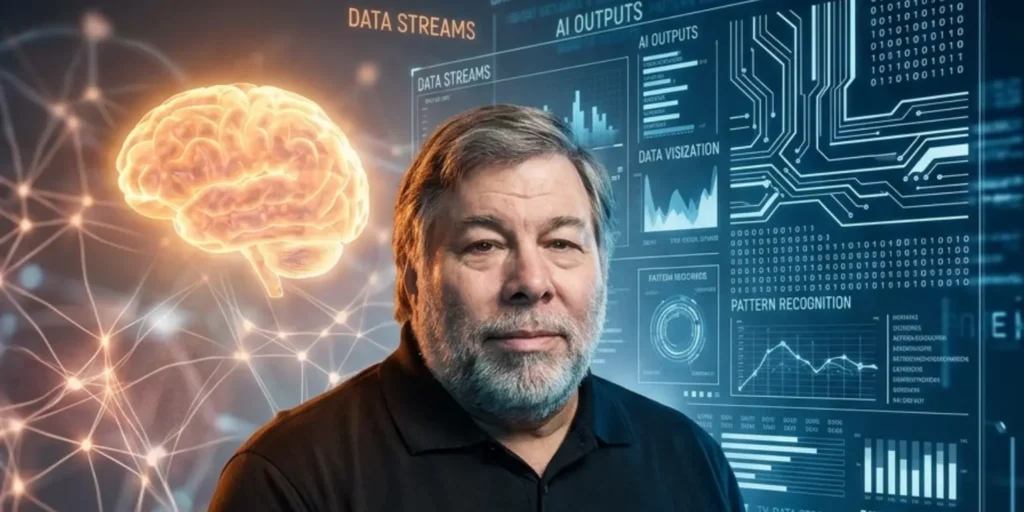
Steve Wozniak with a digital interface behind him, illustrating AI patterns and human cognition, highlighting AI’s lack of true understanding and reasoning.
Tech pioneer and Apple co-founder Steve Wozniak has voiced significant concerns about the current state of artificial intelligence, questioning whether the technology can truly replicate human intelligence or reasoning. His remarks have reignited discussions about the limitations of AI and the potential risks of overestimating its capabilities.
Wozniak’s Skepticism
Speaking at recent public events, Wozniak expressed a measured scepticism regarding AI tools. While he occasionally uses AI systems to test their capabilities, he emphasized that he largely avoids relying on them for substantive tasks. According to Wozniak, AI-generated outputs often appear fluent and structured but fail to demonstrate true comprehension or human-like reasoning.
He noted that AI tends to provide broad, generic answers, especially when questions are phrased in nuanced or specific ways. This, he argued, exposes a fundamental gap between producing coherent responses and demonstrating genuine understanding of intent.
AI Cannot Replace Humans
Wozniak dismissed the notion that AI is close to replacing human intelligence. He highlighted a critical obstacle: our incomplete understanding of the human brain. Scientists still lack a full picture of how cognition, emotion, and reasoning emerge from neural processes. Without this knowledge, Wozniak contends, building machines capable of fully replicating human thought is far from achievable.
“Despite the impressive outputs we see from AI, I have seen no sign that these systems are approaching human-level understanding,” Wozniak stated. He emphasized that while AI can mimic patterns of reasoning and generate polished responses, it cannot truly reason, empathize, or make decisions based on intent, which are fundamental aspects of human intelligence.
Limitations Highlighted by Wozniak
Wozniak’s critique focuses on several key limitations of AI:
- Lack of Comprehension: AI systems may appear to understand language, but they often miss subtle details in queries or misinterpret the intended meaning.
- Absence of Emotion and Empathy: Machines cannot feel, which limits their ability to make decisions that consider human emotional context.
- Mechanical Output: AI-generated content can be overly polished, yet lack individuality or nuance, resulting in responses that feel impersonal.
- Surface-Level Reasoning: While AI can process information and identify patterns, it does not engage in deep cognitive reflection or intuitive judgment akin to human thought.
Wozniak argued that these shortcomings mean AI can, at best, augment human capabilities, not replace them. For example, AI may assist with data analysis, drafting text, or summarizing information, but it cannot replicate human intuition, moral judgment, or emotional intelligence.
Testing AI: Experience vs. Expectation
Wozniak has personally tested AI systems, noting that their outputs often appear impressive on the surface. They generate long, structured, and seemingly coherent responses to a wide range of prompts. However, he emphasizes that the polish of AI outputs does not equate to understanding.
In particular, AI struggles when questions are carefully worded or highly specific, demonstrating a reliance on pattern recognition rather than true comprehension. This limitation is especially evident in professional or high-stakes applications, where nuance and context matter.
The Human Brain vs. Artificial Intelligence
A central theme of Wozniak’s critique is the complexity of human cognition. Despite decades of neuroscience research, the mechanisms that underlie reasoning, intuition, and creativity remain only partially understood. Attempting to reproduce these processes in AI is, therefore, highly speculative.
He emphasized that key human qualities—such as empathy, intent, and emotional intelligence—are non-negotiable components of decision-making and behavior. Machines lack these attributes, and as a result, AI outputs cannot fully capture the depth or subtlety of human thought.
Wozniak’s perspective contrasts with more optimistic views that position AI as a potential replacement for humans in certain fields. Instead, he sees AI as a tool to complement, rather than supplant, human abilities, highlighting the distinction between syntactic fluency (the ability to generate structured responses) and semantic understanding (genuine comprehension).
Examples of AI Shortcomings
In practical terms, Wozniak observed that AI-generated outputs often suffer from:
- Generic Explanations: AI tends to provide broad or generalized answers instead of precise, tailored responses.
- Loss of Individuality: Responses may lack the personality, style, or creativity inherent in human work.
- Mechanical Reasoning: AI applies rules and patterns but does not “think” or reflect on implications.
These limitations can be particularly noticeable in creative or strategic domains, where human judgment, intuition, and emotional insight are essential.
Implications for AI Adoption
Despite Wozniak’s reservations, AI adoption continues to accelerate across industries—from corporate workflows to consumer applications. His critique serves as a cautionary note for organizations and individuals relying heavily on AI outputs.
Key takeaways include:
- AI as an Assistive Tool: Organizations should view AI as a supplement to human decision-making, not a replacement.
- Critical Evaluation Required: Outputs should be critically evaluated rather than accepted at face value, especially in areas requiring nuance or ethical judgment.
- Limits of Automation: The notion that AI can fully replace skilled human labor remains far-fetched in domains requiring creativity, empathy, or complex reasoning.
Wozniak’s comments reinforce the importance of understanding both the capabilities and the limitations of AI systems. While AI excels at data processing and pattern recognition, its lack of genuine comprehension restricts its effectiveness in complex, context-driven tasks.
The Debate Over AI Reliability
Wozniak’s skepticism reflects a broader debate within the tech community. While proponents emphasize AI’s ability to augment human productivity, critics warn against overreliance on systems that do not truly understand or reason.
His remarks also touch on ethical considerations. AI may produce outputs that appear correct but are misleading, biased, or contextually inappropriate. Without human oversight, such errors could have significant consequences, particularly in legal, medical, or policy-related contexts.
AI and Creativity
One of the most contentious areas of AI application is creativity. While AI can generate text, music, or art, Wozniak argues that these outputs are fundamentally different from human-created work.
- Surface-Level Imitation: AI mimics patterns found in existing datasets rather than creating original concepts.
- Lack of Intentionality: Human creativity often arises from a deliberate purpose, emotional drive, or personal perspective—qualities absent in AI.
- Contextual Blind Spots: AI may fail to account for cultural, historical, or emotional context in its outputs.
For Wozniak, these differences underscore why AI cannot yet replace humans in creative or intellectually nuanced tasks.
Public Reaction and Industry Implications
Wozniak’s comments have sparked discussion among tech professionals, policymakers, and the general public. They resonate with users who have encountered limitations or inconsistencies in AI-generated content.
The tech industry may take note in several ways:
- Responsible AI Development: Companies may prioritize explainability, transparency, and contextual awareness in AI systems.
- Human-in-the-Loop Models: Emphasis on systems where humans guide or validate AI outputs.
- Ethical and Policy Considerations: Greater scrutiny over claims that AI can fully replicate human reasoning or decision-making.
Wozniak’s perspective also encourages broader discussions about the role of AI in society and how to integrate it responsibly without overestimating its capabilities.
The Bottom Line
Steve Wozniak’s critique of AI is a reminder that current systems, despite their impressive outputs, remain fundamentally tools rather than independent thinkers. While AI can support human activity, it lacks the empathy, understanding, and nuanced reasoning essential for complex decision-making.
Key points from his remarks include:
- AI produces polished but mechanical outputs.
- Human comprehension, intent, and emotional intelligence remain unmatched.
- AI should be seen as a complement to human work, not a replacement.
- Skepticism and critical evaluation are necessary when using AI in sensitive or high-stakes contexts.
Looking Forward: Apple Co-Founder Steve Wozniak Critiques AI: “Systems Lack True Understanding”
As AI continues to evolve, debates like Wozniak’s will shape public perception, policy, and investment. His insights encourage a balanced approach: leveraging AI’s strengths while remaining vigilant about its limitations.
For consumers, businesses, and policymakers, the key takeaway is clear: AI can be an incredibly powerful tool, but expecting it to replicate the depth, nuance, or empathy of human thought is unrealistic. The future of AI lies in partnership with humans, not in replacement.
About The Author