
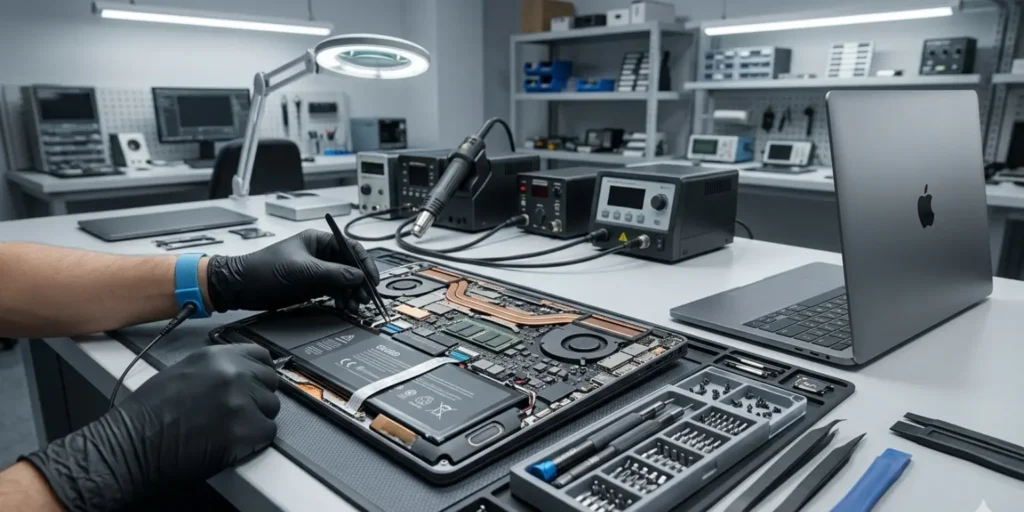
Apple and Lenovo face criticism for poor laptop repairability in new 2026 report.
A new analysis from the Public Interest Research Group Education Fund has put a spotlight on a growing concern in the tech industry: how difficult it has become to repair modern devices. In its latest “Failing the Fix (2026)” report, the group evaluated leading laptop and smartphone manufacturers based on how easy their products are to disassemble, repair, and maintain. The findings reveal a troubling trend, with Apple and Lenovo ranking among the least repairable laptop brands currently on the market.
How Repairability Was Measured
The methodology behind the report is rooted in the French repairability index, a system mandated in France that requires manufacturers to disclose how repairable their devices are. The PIRG Education Fund used this index as a baseline but placed additional emphasis on one key factor: the physical ease of disassembly. This reflects what most consumers intuitively expect when they think about repairability.
The scoring also considered access to repair documentation, availability, and cost of spare parts, and product-specific criteria. On top of that, companies faced penalties if they were members of industry groups like the Consumer Technology Association or TechNet, both of which have historically opposed right-to-repair legislation. Conversely, companies could earn small bonuses for publicly supporting such legislation.
Apple’s Struggles With Repairability
Apple received a C-minus for laptop repairability and an even lower D-minus for smartphones, making it one of the weakest performers in the report. The primary issue lies in the design philosophy of its devices. Apple’s laptops, particularly its MacBook lineup, are known for their sleek, compact builds, but that design often comes at the cost of accessibility.
Low disassembly scores played a major role in dragging down Apple’s rating. Components are tightly integrated, and many parts are difficult to access without specialized tools. This makes even simple repairs, such as replacing a battery or keyboard, far more complicated than they should be.
However, the report does acknowledge some progress. Apple’s introduction of newer models like the MacBook Neo signals a shift toward more repair-conscious design. Additionally, the company has made strides in improving access to repair tools and documentation, as well as introducing features like its Repair Assistant. Despite these improvements, significant barriers remain, particularly with software restrictions and parts pairing systems that limit third-party repairs.
Lenovo’s Ongoing Compliance Issues
Lenovo did not fare much better, earning the second-lowest grade among laptop manufacturers with a C-minus. While the company has shown some improvement compared to previous years, it continues to struggle with both design and compliance issues.
One of the major criticisms highlighted in the report is Lenovo’s inconsistent availability of repairability documentation on its French website. Under French law, manufacturers are required to provide detailed repairability scores for their products. Lenovo had previously faced criticism for failing to meet this requirement, and while progress has been made, the issue has not been fully resolved.
Like Apple, Lenovo also suffers from low disassembly scores, meaning its laptops are not particularly easy to open or repair. This suggests that, despite incremental improvements, the company still has a long way to go in making its devices more user-friendly from a repair standpoint.
A Broader Industry Problem
The report makes it clear that the issue is not limited to just a few companies. Across the board, laptop repairability has remained largely stagnant. While manufacturers have improved access to parts, tools, and repair information, the physical design of devices has not evolved at the same pace.
Nathan Proctor, who leads the Right to Repair campaign at PIRG, noted that improvements in disassembly take longer to implement because they require fundamental changes in product design. Manufacturers must balance durability, aesthetics, and performance with repairability, and often, repairability loses out.
Still, there are signs of progress. Some companies are beginning to experiment with modular designs and easier-to-replace components. These efforts suggest that change is possible, but it will likely take sustained pressure from consumers and regulators to drive widespread adoption.
Smartphone Repairability Paints a Similar Picture
The findings for smartphones are equally concerning. Using the European Commission’s EPREL system, which evaluates factors like disassembly depth, spare part availability, and software support, the report found that many major brands scored poorly.
Apple and Samsung both received low grades, partly because their devices are only guaranteed to receive software updates for five years or less. Software longevity is an important aspect of repairability, as devices that no longer receive updates become less usable over time, even if the hardware is still functional.
Another major issue is parts pairing, a practice where components must be verified through proprietary software to function properly. While Apple has taken steps to reduce its reliance on this system, it still presents a significant barrier for independent repair shops and consumers.
The Role of Right-to-Repair Legislation
The report underscores the importance of right-to-repair legislation in addressing these challenges. Such laws aim to ensure that consumers and independent technicians have access to the tools, parts, and information needed to repair devices.
France has been a leader in this area, requiring manufacturers to display repairability scores on their products. The PIRG Education Fund and other advocacy groups argue that similar requirements should be adopted globally. Doing so would not only empower consumers but also encourage manufacturers to prioritize repairability in their designs.
Interestingly, the report penalizes companies for supporting trade groups that oppose these laws. This highlights the complex relationship between manufacturers and the broader regulatory environment, where business interests sometimes conflict with consumer rights.
Why Repairability Matters More Than Ever
The issue of repairability goes beyond convenience. It has significant environmental and economic implications. Devices that are difficult to repair are more likely to be discarded, contributing to electronic waste. This not only harms the environment but also increases costs for consumers, who are forced to replace devices more frequently.
Improving repairability can extend the lifespan of devices, reduce waste, and make technology more accessible. It also supports a growing ecosystem of independent repair businesses, which can provide more affordable alternatives to manufacturer service centers.
Signs of Progress and the Road Ahead
Despite the challenges, there are reasons for cautious optimism. Companies are beginning to respond to consumer demand for more repairable devices. Initiatives like self-service repair programs and improved access to spare parts indicate that the industry is moving in the right direction.
The example of the MacBook Neo shows that even companies with historically poor repairability scores can make meaningful changes. However, these efforts need to be scaled across entire product lines to have a significant impact.
Ultimately, the future of repairability will depend on a combination of consumer pressure, regulatory action, and industry innovation. As awareness of the issue grows, manufacturers may find that prioritizing repairability is not just a regulatory requirement but also a competitive advantage.
Conclusion
The PIRG Education Fund’s 2026 report paints a clear picture: while some progress has been made, the tech industry still has a long way to go in making devices truly repairable. Apple and Lenovo may be leading the list of underperformers today, but they are also in a position to drive meaningful change.
As repairability becomes an increasingly important factor for consumers, companies that embrace it could gain a significant edge. For now, the message from this report is simple: sleek design and high performance should not come at the expense of repairability.
About The Author