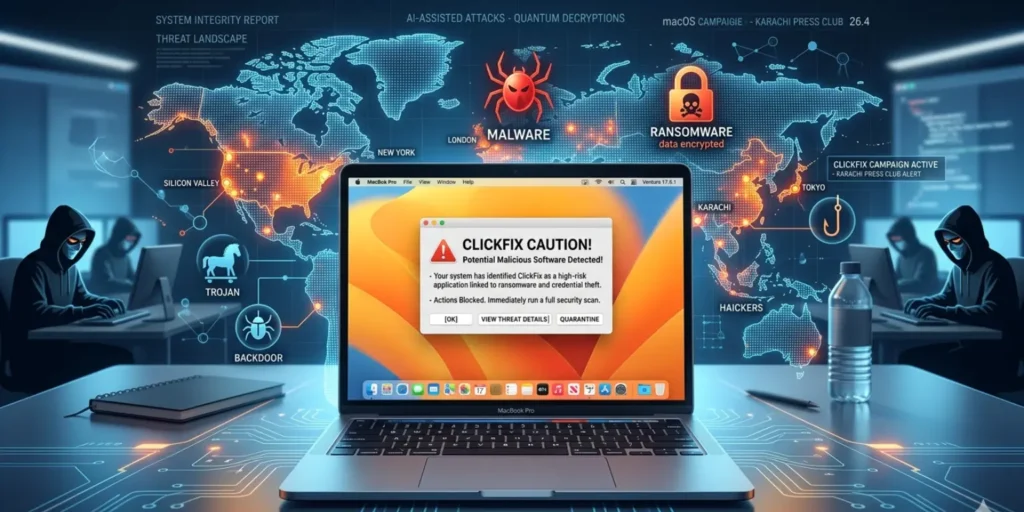
MacBook with ClickFix warning popup, hacker icons, and global cyber threat map highlighting rising malware and state-sponsored attacks.
Apple has quietly introduced a new security feature in macOS 26.4 designed to protect users against a rising malware technique known as ClickFix. This update comes amid a surge in global cyberattacks, including high-profile hacks, ransomware incidents, and vulnerabilities targeting enterprise and government networks.
Understanding ClickFix
ClickFix attacks emerged in the wild in 2024 and have rapidly expanded to target multiple operating systems, including macOS, Windows, and Linux. The technique relies on social engineering: attackers trick users into copying and pasting code from websites into terminal windows.
These websites often display fake errors, broken CAPTCHA, or misleading instructions, encouraging the victim to run a block of code that, while seemingly harmless, downloads and installs malware.
Initially, ClickFix attacks focused on Windows environments, but towards the end of 2025, macOS and Linux systems became primary targets. Security firm Huntress reports that more than half of the malware incidents they tracked in 2025 originated from ClickFix-related delivery points.
Apple’s new feature shows a pop-up warning whenever a user attempts to paste commands from a browser into the Terminal. The pop-up does not block the action, but it raises awareness among less technical users, helping them avoid inadvertently running malicious scripts.
High-Profile Hacks and Breaches
The cybersecurity landscape continues to be highly volatile, with breaches affecting governments, enterprises, and blockchain platforms.
1. Handala Hacks Kash Patel
Iranian hacking group Handala reportedly breached the personal Gmail account of FBI Director Kash Patel, leaking sensitive emails. The FBI has confirmed the breach. Handala is linked to Iran’s MOIS intelligence service, highlighting the persistent threat of state-sponsored cyber operations targeting high-level U.S. officials.
2. BreachForums v5 Compromised
The notorious hacker forum BreachForums was compromised days into its fifth incarnation. Attackers leaked registration data and private messages of over 340,000 users. This follows a pattern of BreachForum clones being targeted, with the latest leak executed by the ShinyHunters group.
3. CareCloud Breach
Electronic health record (EHR) provider CareCloud experienced a breach that affected one of its six platforms. The company claims to have evicted the attacker within eight hours. Health sector breaches remain a major concern due to sensitive personal data and potential disruption to patient care.
4. Balancer DeFi Hack
The Balancer decentralized finance (DeFi) platform shut down after hackers stole $110 million from its coffers. The closure reflects the legal and operational risks associated with DeFi platforms and highlights the vulnerabilities of decentralized financial infrastructure.
5. Crypto-Theft Using CCTV
A UK man accused his former wife of stealing $176 million in cryptocurrency using CCTV surveillance to capture his wallet passwords. This incident underscores how physical security lapses can be exploited to perpetrate large-scale cyber theft.
6. Ransomware Hits Jackson County
The Sheriff’s Department in Jackson County, Indiana, suffered a ransomware attack that crippled its IT systems, including PCs, WiFi, and reporting systems. The attack reportedly stemmed from a malicious email attachment, demonstrating the ongoing effectiveness of simple phishing techniques against government entities.
Supply Chain and Developer Platform Compromises
Attackers are increasingly targeting development platforms and supply chains to maximize the impact of their operations.
- Apifox CDN: Malicious JavaScript code was inserted into the desktop client of the Chinese web development service Apifox, stealing user credentials.
- Telnyx SDK: Hackers backdoored the Python library for voice AI provider Telnyx, compromising thousands of organizations via a multi-phase supply chain attack.
- VS Code Extensions: Threat actors compromised IoliteLabs extensions for Solidity blockchain development, allowing malicious code execution.
These incidents reflect a growing trend in supply chain attacks, where hackers infiltrate widely used tools to scale their operations.
European Union Cybersecurity Actions
The EU has taken regulatory steps in response to cyber and AI risks:
- AI Nudifier Apps Ban: Any application creating sexualized deepfakes without consent is now prohibited under the updated EU AI Act.
- Lawmakers’ Travel Precautions: EU officials visiting China are required to leave personal devices at home and use secure burner devices to prevent espionage.
These measures illustrate increasing governmental concern over both malicious software and AI-driven risks.
Vulnerabilities and Patch Management
Cybersecurity researchers have discovered and reported numerous vulnerabilities, ranging from enterprise servers to VPN solutions:
- F5 BIG-IP: Remote code execution vulnerabilities continue to be exploited, prompting urgent patching by affected organizations.
- Citrix NetScaler: A patched vulnerability (CVE-2026-3055) has already been targeted in honeypots.
- strongSwan VPN: CVE-2026-25075 allows attackers to take VPN services offline.
- EspoCRM RCE: The popular open-source CRM patched a remote code execution flaw.
- ArangoDB AQL Injection: SQL-like injection attacks continue to pose risks in database query languages.
In addition, research indicates that Windows PCs crash three times more frequently than Macs in enterprise environments, and Macs tend to be replaced less frequently, highlighting relative operational stability and longevity.
Emerging Malware and Threat Actors
The threat landscape continues to diversify, with both classic and new attack vectors:
- CTRL Framework: A .NET post-exploitation framework observed in the wild, attributed to Russian-speaking developers.
- Pay2Key Ransomware: Linked to Iran, resurged during the US-Israel-Iran conflict.
- Mirax Trojan: Android banking trojan sold under a Malware-as-a-Service (MaaS) model.
- Aura and MaskGram: Infostealers targeting credentials and using social platforms for command-and-control.
- Drifter Botnet: Android DDoS botnet leveraging C2 domains that mimic camera/CCTV brands.
APT groups and nation-state actors remain active:
- US Offers Rewards: The U.S. State Department offers up to $10 million for information on Iranian hacking groups.
- Russian APT DarkSword: Spear-phishing campaigns target iOS users in Lithuania and beyond.
- SE Asia APTs: Multiple clusters targeting Southeast Asian governments with malware, including USB spreaders.
The integration of AI into cybercrime is still nascent but growing, with attackers using AI for reconnaissance, intrusion, and malware development.
Tools and Security Innovation
Security vendors continue to release tools to help organizations stay ahead of threats:
- Hadrian: Open-source API security testing framework.
- ForceHound: Salesforce identity and permission graph collector.
- DVRTC: Vulnerable lab environment for VoIP/WebRTC security learning.
- VulnRadar: Vulnerability intelligence platform leveraging GitHub Actions.
- filterforge: Toolkit for reverse-engineering Berkeley Packet Filter bytecode.
- Rustunnel: Secure tunnel server written in Rust.
- owLSM: Linux eBPF agent for endpoint monitoring and detection.
These tools aim to address modern threats, including API vulnerabilities, cloud security gaps, and real-time monitoring challenges.
Risky Business Podcast Highlights
Security discussions in podcasts continue to shed light on trends:
- Seriously Risky Business: Tom Uren and Amberleigh Jack highlighted that the FBI collects Americans’ location data for intelligence, raising privacy concerns.
- Between Two Nerds: Discussions focused on iOS exploit kits and Russian attacks on cryptocurrency infrastructure, examining how state and criminal actors exploit system vulnerabilities.
Podcasts provide accessible analysis for practitioners and enthusiasts to track evolving threats.
Conclusion: Apple Adds ClickFix Warning to macOS as Global Cybersecurity Threats Surge
Apple’s ClickFix warning in macOS 26.4 represents a small but important step in educating users against sophisticated social engineering attacks. However, the broader cybersecurity ecosystem is under increasing strain, with state actors, ransomware gangs, supply chain attacks, and AI-assisted cybercrime all converging.
Organizations, governments, and users face a dual challenge: staying updated with patches and technical defenses while maintaining awareness of human-centric threats like ClickFix. Meanwhile, global regulatory frameworks, such as the EU’s AI Act, are beginning to address ethical and security implications of new technologies.
From Iranian hackers targeting high-level officials to DeFi platforms losing hundreds of millions, the cybersecurity landscape remains perilous. For enterprises, governments, and individuals, vigilance, layered security, and awareness are critical.
In 2026, staying safe online is no longer just about antivirus software—it requires understanding geopolitical, technical, and social engineering dimensions, all of which continue to evolve rapidly.
About The Author