
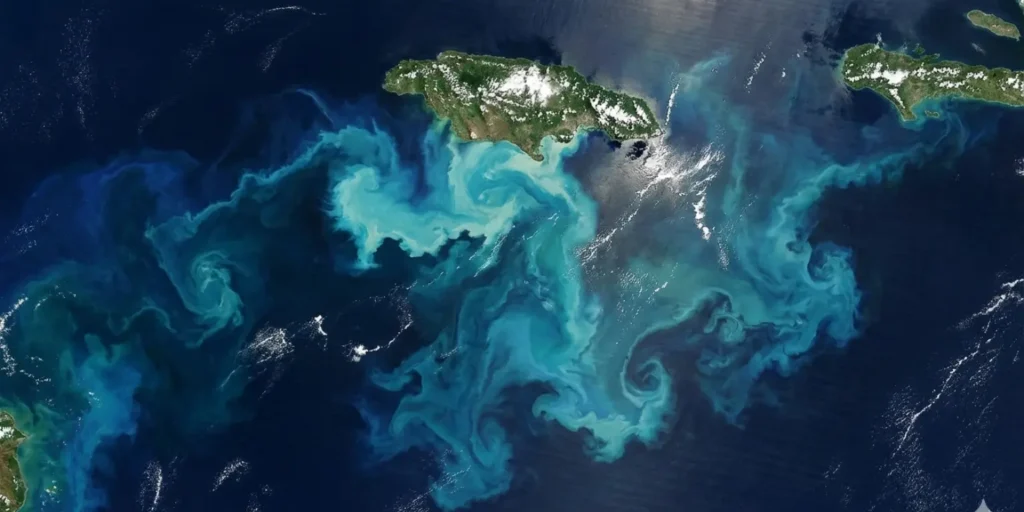
A vivid blue sediment trail appears in the ocean south of Jamaica after Hurricane Melissa stirred the seafloor, as seen by NASA satellites.
When Hurricane Melissa struck Jamaica on October 28, 2025, it arrived as a powerful Category 5 storm. Winds reached nearly 295 kilometers per hour, tearing through communities across the island. Tens of thousands of people were forced from their homes. More than 100,000 buildings were damaged or destroyed. Farms suffered heavy losses, and forests were left stripped and brown. At the same time, the storm transformed the waters south of the island, churning the sea and leaving behind a striking, bright blue ocean that later caught the attention of scientists and satellite observers.
While the human toll was severe, the hurricane also caused a dramatic and rare event in the ocean south of Jamaica. Before hitting land, Melissa moved slowly across the Caribbean Sea. As it passed over shallow underwater platforms, it stirred the ocean with enormous force. A few days later, when clouds finally cleared, satellites revealed something striking. Large areas of the sea had turned a vivid blue.
A Rare Sight from Space
On October 30, NASA’s Terra satellite captured images of the waters south of Jamaica using its MODIS instrument. The images showed a wide plume of bright blue water spreading across the sea. Scientists believe this was one of the largest sediment events ever recorded by satellites in the region.
The blue color came from sediment lifted off the seafloor of Pedro Bank. This underwater plateau sits about 25 meters below the surface and is slightly larger than the U.S. state of Delaware. Under normal conditions, Pedro Bank is barely visible in satellite images. It only becomes noticeable when powerful storms disturb the water above it.
For comparison, scientists looked at satellite images taken before the storm in September. At that time, the water appeared calm and uniform, with no sign of the bright blue plume seen after Melissa passed through.
What Turned the Water Blue
The unusual color came from calcium carbonate sediment that was pulled up from the seafloor. This fine mud is made mostly of broken shells and remains of tiny marine organisms that live on the bank. When suspended in water, the sediment reflects light in a way that creates a soft blue shade often called Maya blue.
This color is different from the murky green or brown water seen near river mouths after heavy rain. In those cases, sediment comes from land. Here, the source was entirely underwater.
James Acker, a scientist who studies satellite ocean data, explained that Hurricane Melissa had exceptional power. While past storms have disturbed Pedro Bank, none have done so at this scale. He noted that although disasters bring suffering, this event offered a rare look at powerful natural processes.
A Massive Area Affected
Scientists tracking the sediment found that it spread across about 37,500 square kilometers of ocean. That is more than three times the size of Jamaica itself. Jude Wilber, a sediment expert who followed the plume using multiple satellites, said this was the largest event of its kind seen during the satellite era.
The sediment acted like a natural tracer, allowing scientists to see how ocean currents moved near the surface. Some of the blue plume flowed west and north, carried by the Caribbean Current. Other sections moved in different directions, shaped by winds and rotating water patterns.
In one area, the plume split into three parts after running into small reefs. In another section, sinking sediment formed a stepped pattern as it dropped through the water. These details helped researchers understand how water and particles move during extreme storms.
Short-Term Color, Long-Term Effects
The bright blue color did not last long. Within about a week, most of the sediment settled back to the seafloor, and the water returned to its usual appearance. However, scientists believe the effects on Pedro Bank itself may last much longer.
Wilber suspects the storm was strong enough to wipe out much of the life living on the bank. Seagrass, algae, and other bottom-dwelling organisms were likely destroyed or buried. How quickly these ecosystems will recover remains uncertain.
Such damage can change how the bank functions for years, affecting fish habitats and the balance of marine life in the area.
Why This Matters for the Planet
Beyond local damage, the event has global importance. Tropical storms like Melissa play a role in Earth’s carbon cycle. When sediment from shallow areas is pushed into deeper water, carbon can be stored there for very long periods.
At greater depths, carbonate sediment can slowly dissolve, influencing ocean chemistry and helping regulate carbon levels. Events like this one move large amounts of material in a short time, making them important to study.
Satellites have made it possible to observe these processes almost continuously. Scientists like Acker and Wilber have worked for years to measure how much sediment storms send into the deep ocean. Past research included studies of hurricanes in the Gulf of Mexico.
New Tools for Future Study
New satellite missions are expected to improve understanding even further. NASA’s PACE mission, launched in early 2024, provides detailed measurements of ocean color and composition. These observations allow scientists to track sediment and biological changes with greater accuracy.
The Pedro Bank event offers a unique chance to test these tools. Researchers plan to study the physical movement of water, chemical changes, and biological impacts linked to the storm.
Wilber described the event as a complete lesson in ocean science. It showed how powerful storms connect the atmosphere, the ocean floor, marine life, and the global climate system.
A Natural Experiment
Hurricane Melissa caused widespread destruction on land, but it also revealed a dramatic process beneath the sea. The bright blue plume south of Jamaica was more than a striking image. It was a reminder of how much energy storms carry and how deeply they can reshape the natural world.
For scientists, this rare event provided insights that could not be recreated in any lab. For the planet, it showed once again how closely weather, oceans, and climate are linked.
About The Author